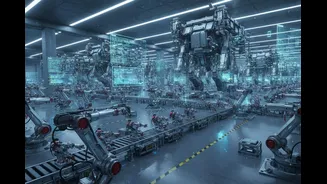







The technology sector is in the midst of a strange paradox. Companies are pouring billions into artificial intelligence, hailing it as the future of growth, yet many are simultaneously laying off thousands of workers.
The Great Contradiction in Tech
In 2026 alone, the tech industry has
seen hundreds of thousands of job cuts, with major players like Amazon, Microsoft, Dell, and Meta reducing their workforces. These aren't small trims; some companies have cut staff by 10% or more. For instance, in the first eleven months of 2026, more than 180,000 roles have been cut due to AI-related restructuring. This trend continues a pattern from previous years, with the number of AI-related layoffs increasing significantly since 2024. At the same time, these very companies are leading a historic spending spree on AI. Combined spending on AI infrastructure is projected to exceed $730 billion this year, with giants like Google, Amazon, and Microsoft committing tens of billions to develop advanced AI models and data centers. This has led to a confusing reality for employees: the industry is booming with investment in the future, but contracting in its present-day workforce.
A Pivot, Not Just a Cutback
Company announcements reveal this isn't a simple cost-cutting exercise. It’s a strategic pivot. Many executives are explicitly linking layoffs to their AI ambitions. The cuts are often framed as a way to fund massive AI investments or a consequence of AI-driven efficiencies. Companies are eliminating roles deemed redundant in an AI-driven operational model to redirect resources toward AI development. Block, for example, attributed a major restructuring to its push to automate work through AI. Similarly, Oracle noted that its adoption of AI has resulted in workforce reductions. This signals a fundamental rewiring of corporate strategy, where human capital is being reallocated to align with a future built on artificial intelligence.
The New In-Demand Skillset
As old roles are eliminated, a new set of jobs is emerging, all centered around AI. The skills in highest demand are no longer just traditional software engineering. Instead, companies are hunting for talent in prompt engineering, machine learning, data engineering, and MLOps. There's also a growing need for people with 'AI literacy' — the ability to use AI tools effectively and critically evaluate their outputs, a skill that often doesn't require coding knowledge. Hiring managers are increasingly focused on whether candidates have demonstrated creative uses of AI tools, with the focus on this quadrupling for some non-technical roles since 2024. This shift is creating a skills gap, where many existing workers may not have the training for the new roles their employers are prioritizing.
The Human Cost and the Road Ahead
This transition has a significant human cost, leaving many experienced professionals displaced. However, the story has another twist: some companies that moved too quickly to replace humans with AI are reportedly having to rehire them. One report from March 2026 found that 32% of organizations that dismissed workers because of AI subsequently had to rehire staff, often at a higher cost. Workers who do return are demanding better pay, job security guarantees, and transparency about how AI will be used in their roles. This suggests that the relationship between human labor and AI is more complex than a simple replacement. For the workforce, the message is clear: the era of AI is not about the end of work, but a radical reshaping of it. Continuous learning and upskilling are no longer professional development buzzwords but essential survival tools in a rapidly changing industry.