


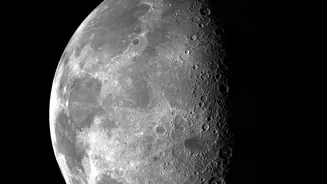
A Tale of Two Different Faces
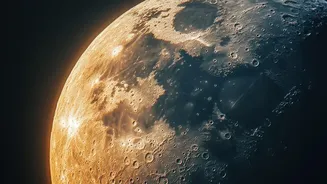
Anyone looking up at the night sky is familiar with the 'man in the Moon'. These dark patches, known as 'maria' or seas, are vast plains of ancient, solidified lava. They dominate the Earth-facing side of the Moon, giving it its distinctive piebald appearance.
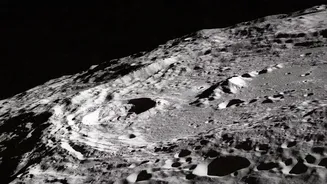
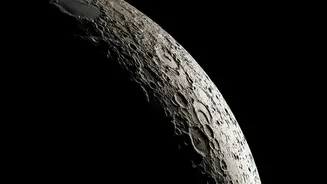
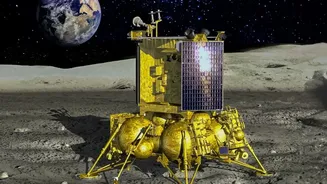
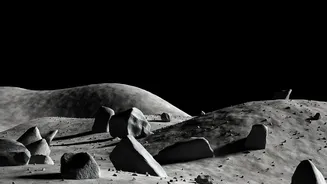
But the other side tells a very different story. When the Soviet probe Luna 3 first sent back pictures of the lunar far side in 1959, scientists were stunned. Instead of smooth, dark plains, they saw a surface that was almost entirely composed of pale, heavily cratered highlands. The crust was also found to be significantly thicker. This stark difference, known as the lunar asymmetry, has puzzled scientists for over half a century. Why would one celestial body have two such dramatically different hemispheres? The answer, it turns out, was waiting in the rocks.
Clues from the Apollo Missions
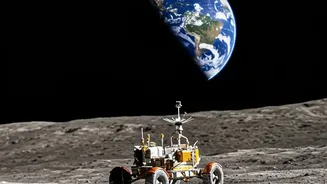
The first major clues arrived with the Apollo missions. Between 1969 and 1972, astronauts brought back over 800 pounds of lunar rocks and soil. Analysis of these samples confirmed that the dark maria were volcanic in origin. They also revealed an unusual geochemical signature on the near side, a composition rich in potassium (K), rare-earth elements (REE), and phosphorus (P), which scientists nicknamed KREEP. This material was concentrated on the near side, suggesting that the mantle beneath it was hotter and had a different composition, which fueled the volcanic activity that formed the dark plains. However, without samples from the far side, this was only half of the story. Scientists could only compare the near side rocks to what they could observe from orbit on the far side, leaving the ultimate cause of the asymmetry a subject of intense debate.
A Breakthrough from the Far Side
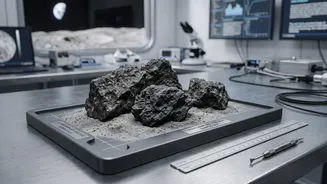
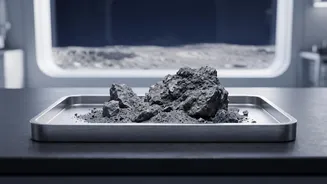
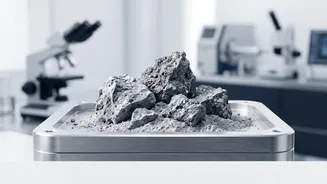
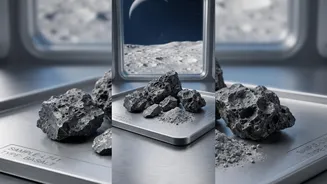
The game changed with China's recent lunar missions. The Chang'e-6 mission, in a remarkable feat of robotic engineering, successfully landed in the Moon's South Pole-Aitken Basin—the largest, deepest, and oldest impact crater in our solar system—and returned the first-ever samples from the lunar far side. For the first time, scientists could perform a direct, side-by-side comparison of rocks from both hemispheres. These precious grams of dust and rock provided the ground truth needed to test the various theories about the Moon's lopsided evolution. Chinese scientists have been leading the analysis, building sophisticated models using the new data to map the chemical composition of the far side with unprecedented accuracy.
Forged by Impact and Heat
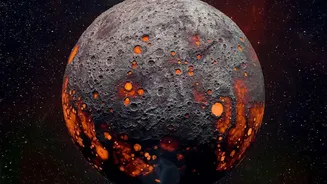
The new samples are helping to confirm a leading theory: the asymmetry was caused by cataclysmic events in the Moon's distant past. One hypothesis suggests the colossal impact that formed the South Pole-Aitken Basin over four billion years ago played a key role. Such a massive strike would have excavated deep into the Moon's mantle, altering its internal heat flow and contributing to the different geological paths taken by the two hemispheres. Another recent study, also analyzing Chang'e-6 samples, points to uneven heating from Earth's own gravity. According to this research, after the Moon became tidally locked with Earth (keeping one face permanently toward us), the constant gravitational pull generated enormous flows of magma within the ancient Moon. This process may have concentrated heat-producing radioactive elements on the near side, creating the volcanic plains, while the far side cooled more uniformly, preserving its ancient, cratered crust.
Why Solving This Mystery Matters
Understanding the Moon's two-faced nature is about more than just satisfying scientific curiosity. Because the Moon lacks the tectonic activity and significant erosion that constantly resurfaces our own planet, its surface is a pristine record of the early solar system. By studying how the Moon formed and evolved, we gain a unique window into the violent processes that shaped all the rocky worlds, including Earth. The Apollo samples have been providing insights for over 50 years, and with new material from the far side, scientists are continuing that legacy. The lessons learned from analyzing these tiny rock fragments inform our understanding of planetary formation and even guide the plans for future missions, such as NASA's Artemis program, which aims to return humans to the lunar surface.