






A Critical Test for a National Dream
On July 7, 2026, the Indian Space Research Organisation (ISRO) successfully conducted a major parachute test, a vital milestone for the Gaganyaan human spaceflight program. The test, known as the Integrated Main Parachute Airdrop Test (IMAT-05), took
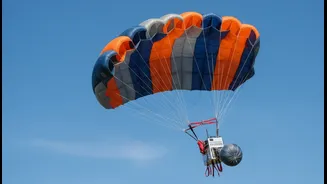
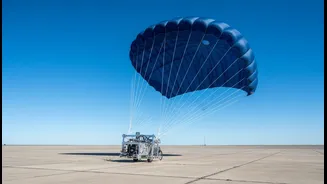
place at the Aerial Delivery Research and Development Establishment (ADRDE) drop zone in Sheopur, Madhya Pradesh. Its objective was to prove the strength and reliability of the main parachutes under the most stressful conditions expected during the first uncrewed Gaganyaan (G1) mission. A dummy payload, matching the weight of the actual crew module, was dropped from an Indian Air Force IL-76 aircraft at an altitude of 2.5 kilometers to simulate the capsule's return to Earth. This successful trial builds immense confidence in the systems designed to bring Indian astronauts, or 'vyomanauts', home safely.
The Science of Slowing Down
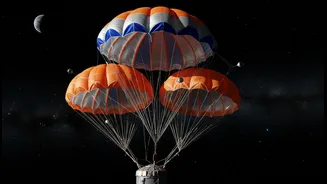
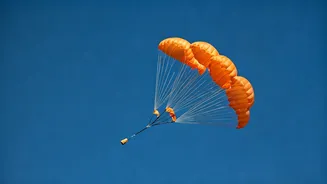
Bringing a spacecraft back from orbit is a violent affair. The Gaganyaan crew module will re-enter the atmosphere at tremendous speeds, and its survival depends on a flawlessly executed deceleration sequence. This is where the parachutes come in, but it's far more complex than a single piece of fabric. The entire system consists of ten parachutes of four different types working in a precise, automated sequence. The process starts with two Apex Cover Separation parachutes, which jettison the cover protecting the parachute compartment from the intense heat of re-entry. This is immediately followed by two Drogue parachutes. These are not the main brakes but are essential for stabilizing the rapidly falling capsule, preventing it from tumbling and reducing its speed significantly.
An Intricate Parachute Ballet
Once the drogue chutes have done their job and the module is stable, the main event begins. Three pilot parachutes are deployed, each tasked with pulling out one of the three large main parachutes. These main parachutes are the final and most critical stage, designed to slow the capsule to a gentle speed for a safe splashdown in the ocean. The system is built with redundancy; while there are three main parachutes, only two are required for a safe landing, with the third acting as a crucial backup. The recent IMAT-05 test specifically focused on the deployment and performance of one of these main parachutes, ensuring it can handle the immense loads and perform exactly as designed.
A Collaborative National Effort
The success of this test highlights the remarkable collaboration between several of India's premier organizations. While ISRO leads the Gaganyaan program, the parachute system is jointly developed with the Defence Research and Development Organisation (DRDO). The test itself was a combined effort involving ISRO, DRDO, the Indian Air Force, which provided the IL-76 transport aircraft, and the Indian Army. This multi-agency partnership is fundamental to the entire human spaceflight program, pooling the nation's best resources and expertise to tackle the immense challenges of sending humans into space and ensuring their safe return.
The Road Ahead to Orbit
The successful IMAT-05 is the fifth in a series of such tests required to qualify the parachute system for flight. Each test pushes the system to its limits, sometimes simulating failure scenarios to ensure the backups work perfectly. With every successful test, ISRO moves closer to the first uncreed Gaganyaan mission, designated G1, which will serve as the ultimate dress rehearsal before Indian astronauts strap in. This mission will validate all the critical systems in a real space environment, from the human-rated LVM3 rocket to the crew module's life support and, of course, the parachute landing system that has just proven its mettle once again.