



A Panoramic Window to the Cosmos
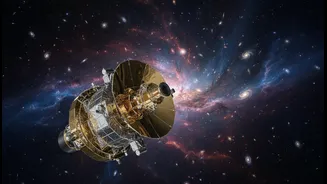
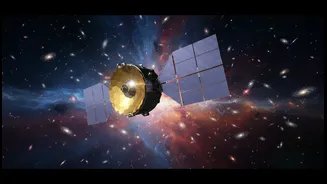
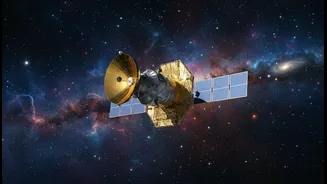
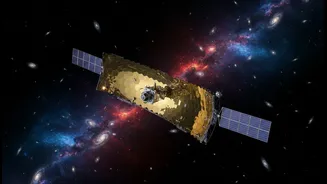
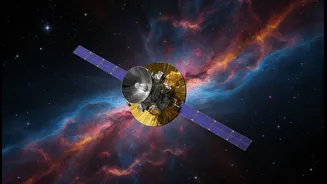
The single greatest advantage of the Roman Telescope is its incredible field of view. While it has the same size primary mirror as the Hubble Space Telescope, its Wide Field Instrument will capture an area of the sky at least 100 times larger in a single snapshot.
This means that where Hubble provides a detailed, zoomed-in look at a small patch of sky, Roman will deliver breathtaking panoramas with the same sharp resolution. This capability will allow it to conduct massive surveys with unprecedented efficiency, creating enormous maps of the universe. In the time it takes Hubble to image one or two galaxies, Roman will capture thousands, fundamentally changing the scale of cosmic data available to scientists.
The Hunt for Dark Energy and Dark Matter
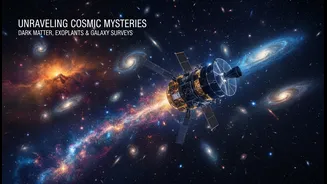
Two of the biggest mysteries in cosmology are dark energy and dark matter, the invisible components that are believed to make up about 95% of the universe. Roman is specifically designed to tackle these questions. By surveying billions of galaxies and observing thousands of distant supernovae (exploding stars), the telescope will measure the expansion history of the universe with extreme precision. These measurements will help scientists determine if the accelerating expansion is caused by a constant form of dark energy or something else entirely. Additionally, by studying how the light from distant galaxies is bent by the gravity of intervening matter—a technique called weak gravitational lensing—Roman will create a new map of how dark matter is distributed throughout the cosmos.
A New Census of Alien Worlds
Beyond cosmology, Roman is set to become a prolific exoplanet hunter. While previous telescopes primarily found planets orbiting very close to their stars, Roman will use a technique called gravitational microlensing to find worlds on wider orbits, more similar to our own solar system. This method works by observing the light from a distant star as a closer star passes in front of it. The gravity of the foreground star (and any planets it has) acts like a lens, magnifying the background starlight in a way that reveals the planets' presence. It's projected that Roman could discover on the order of 100,000 new exoplanets this way, dramatically increasing the number of known worlds and providing a more complete picture of planetary systems across our galaxy.
What Still Needs Checking
Despite the immense promise, the mission is not yet a reality. The telescope, which completed construction and assembly in late 2025 and early 2026, is now undergoing a rigorous series of final tests. These environmental checks are designed to ensure its complex systems can withstand the harsh conditions of launch and the vacuum of space. The official launch date is currently listed as August 30, 2026, aboard a SpaceX Falcon Heavy rocket. As with any major space mission, this date remains a target on a planning calendar, contingent on every component passing its final checks without issue. The team must ensure that every part, from the mirror to the sensitive detectors, performs exactly as designed.
Technology on Trial
Roman is also a proving ground for future technology. In addition to its main wide-field camera, the telescope carries a Coronagraph Instrument. This device is a technology demonstrator designed to block the overwhelming glare from a star, allowing astronomers to directly image the faint planets orbiting it. While this instrument is expected to capture images of only a handful of nearby giant planets, its performance is critical. It will test key technologies needed for a future mission, the Habitable Worlds Observatory, which aims to directly detect and characterize Earth-like planets around other stars. The success of this demonstration will pave the way for the next generation of telescopes tasked with searching for life beyond our solar system.