




Understanding the Celestial Event
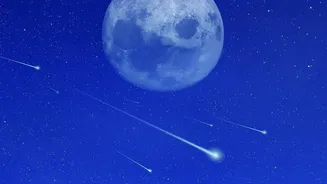
When two celestial objects appear close to each other in the sky from our vantage point on Earth, it’s called a conjunction or a close approach. Though they look like neighbours, the Moon and Saturn are, of course, separated by an enormous distance—over
1.2 billion kilometres. This month provides a fantastic opportunity to see them share the same patch of sky, an alignment that is both beautiful and a great chance to easily identify a distant planet.
Best Dates and Times for Viewing
Mark your calendars for the nights of October 24 and 25, 2026. This is when the almost-full Moon will make its close approach to Saturn. The spectacle will be visible for most of the night. On the evening of October 24, you can see the pair in the sky after sunset, with the Moon appearing near the bright planet. The following night, October 25, offers another excellent viewing opportunity. The peak full moon, known as the Hunter's Moon, officially occurs on October 26, meaning the Moon will be exceptionally bright during this alignment. For viewers in India, Saturn will rise in the eastern sky around sunset, making it visible throughout the evening and night.
How to Find the Moon and Saturn
Finding the pair will be straightforward. After sunset on October 24 and 25, simply look for the bright Moon. Nearby, you will spot a distinctly bright, non-twinkling point of light—that will be Saturn. Planets tend to shine with a steady light, unlike stars which twinkle due to atmospheric disturbances. Saturn will appear as a creamy-white or pale yellow object. If you need a landmark, Saturn can be found beneath the Great Square of Pegasus, a large, distinctive square of four stars in the eastern sky after dark. Using a stargazing app on your phone can also help you get oriented, but the Moon will be your best guide on these nights.
Tips for an Optimal Viewing Experience
The great news is that you don't need any special equipment to see Saturn itself; it's easily visible to the naked eye. However, to truly appreciate the spectacle, a few tips can enhance your experience. First, find a location with a clear view of the horizon, away from the direct glare of city and street lights. While bright planets aren't completely washed out by light pollution, darker skies always provide a sharper view. Give your eyes about 15-20 minutes to adjust to the darkness; this will help you see fainter details. While you can spot Saturn without aid, its famous rings are only visible through a telescope or a good pair of high-powered binoculars. A magnification of at least 25-35x is generally recommended to make out the rings.
Why This Sighting Is Special
This year’s viewing of Saturn is particularly rewarding. The planet reached opposition on October 4, 2026, the point where Earth passes directly between the sun and Saturn. This alignment means the planet is at its closest to Earth for the year, making it appear bigger and brighter than usual. Furthermore, Saturn's rings are tilted towards us at an angle of about 7 degrees this year, making them easily visible in telescopes after being nearly edge-on and hard to see in 2025. This close approach with the Moon provides a perfect signpost, drawing your eye directly to the magnificent ringed planet during one of its best viewing periods.