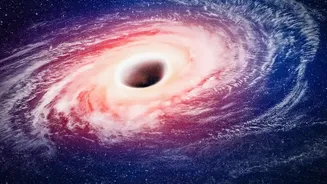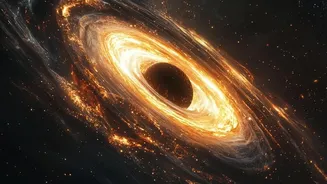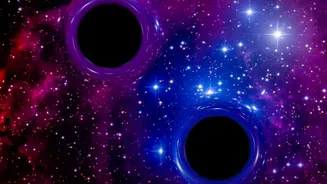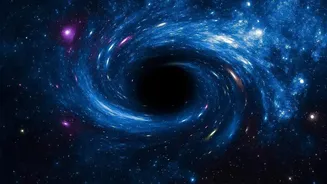



The universe is full of massive objects, but nothing compares to what scientists are now imagining. Forget supermassive black holes; a new class of hypothetical giants, with masses over 100 billion times that of our sun, could be out there.
Beyond Supermassive: A New Class of Giant
At the heart
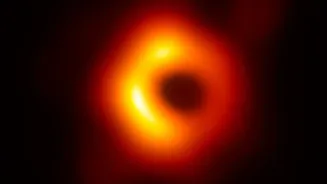
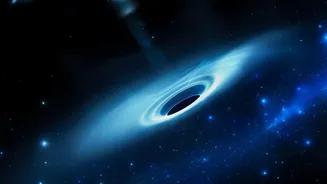
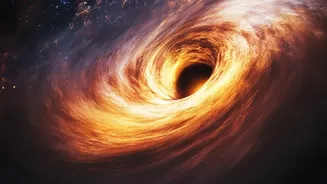
of most large galaxies, including our own Milky Way, lurks a supermassive black hole (SMBH). These cosmic titans can weigh millions or even billions of times the mass of our sun. For a long time, astronomers believed there was an upper limit to their size, dictated by how much matter they could consume over the age of the universe. The largest confirmed black hole, TON 618, clocks in at a staggering 66 billion solar masses. However, a new theory posits the existence of 'Stupendously Large Black Holes', or SLABs. These aren't just bigger; they represent an entirely different category of object, potentially exceeding 100 billion solar masses and rewriting the rules of cosmic formation.
A Primordial Recipe for Giants
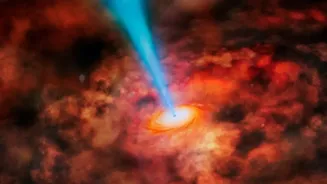
So, how could something so enormous possibly form? Standard black holes are born from the collapse of massive stars and grow by accreting gas, dust, and other stars. This process is relatively slow and messy; as matter falls in, it heats up and creates outward pressure that can push away potential fuel. This 'Eddington Limit' puts a natural brake on how fast a black hole can grow. SLABs would need a different origin story. The leading theory is that they are 'primordial black holes' (PBHs), formed not from stars but from immense density fluctuations in the hot, soupy universe just moments after the Big Bang. Instead of building up over time, they would have been born colossal, sidestepping the growth limits that constrain their star-born cousins.
Cosmic Growth Without a Meal
Another radical idea that could contribute to the growth of massive black holes is 'cosmological coupling'. This theory suggests that black holes might not need to eat to grow. Instead, their mass could increase in lockstep with the expansion of the universe itself. As spacetime stretches, the black hole, being intrinsically linked to it, also expands, gaining mass from the energy of that expansion. Researchers studying supermassive black holes in ancient, dormant galaxies found they had grown more massive than could be explained by mergers or gas accretion alone, lending the first observational evidence to this mind-bending concept. If true, this means the universe itself could be feeding its largest inhabitants, potentially allowing them to reach stupendous sizes over billions of years.
Where Are These Monsters Hiding?
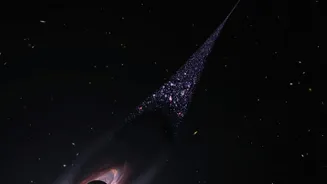
If SLABs exist, they would likely be found in the vast, dark voids of intergalactic space rather than at the centers of galaxies. Their primordial origin means they predate the formation of galaxies themselves. Because they are not actively feeding on huge amounts of gas, they wouldn't produce the intensely bright quasars that make their smaller supermassive counterparts easier to spot. Detecting them is a huge challenge. However, scientists have proposed clever ways to look for them. One method is to search for their shadows against the cosmic microwave background—the faint afterglow of the Big Bang. Another is to look for the effects of their immense gravity, which could bend and magnify the light from distant objects in an effect known as gravitational lensing.
Rethinking Dark Matter and the Universe
The existence of SLABs wouldn't just be a record-breaking discovery; it would have profound implications for our understanding of the cosmos. For one, it would lend strong support to the theory of primordial black holes. While SLABs themselves are likely too large and too rare to be the dark matter that makes up most of the universe's mass, their existence would imply that smaller primordial black holes could be a viable candidate. Furthermore, if these giants formed from density fluctuations in the early universe, they would have acted as massive gravitational anchors, seeding the large_scale cosmic web of galaxies and clusters we see today. Finding a SLAB would not just introduce us to a new cosmic monster; it could help solve the enduring mystery of dark matter and explain the very architecture of our universe.