






A Candidate for an Ocean World
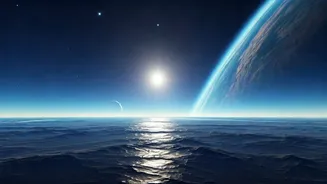
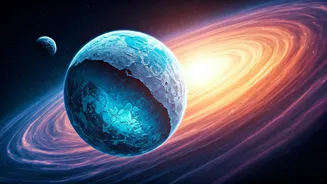
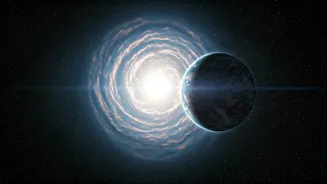
The subject of all this excitement is an exoplanet named K2-18 b. It’s about 8.6 times more massive than Earth and orbits a red dwarf star in the “habitable zone”—the region where conditions could be right for liquid water to exist. For years, K2-18 b has
been a prime candidate for a theoretical type of planet known as a “Hycean” world. First proposed in 2021, the Hycean model describes a planet completely covered by a deep, liquid water ocean lying beneath a thick, hydrogen-rich atmosphere. If such worlds exist, they could be one of the most common types of habitable planets in our galaxy, making them a top priority in the search for life.
Webb's Definitive Detections
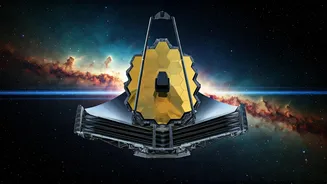
Using its powerful instruments, the James Webb Space Telescope has given us our most detailed look yet into the atmosphere of K2-18 b. In 2023, observations confirmed the presence of carbon-bearing molecules, including significant amounts of methane and carbon dioxide. Crucially, the telescope did not detect large amounts of ammonia. This chemical profile—an abundance of methane and CO2 but a lack of ammonia—is exactly what scientists predicted they would find on a planet with a water ocean. These findings strengthened the case for K2-18 b being a genuine Hycean world, setting the stage for an even more tantalizing discovery.
The Tantalizing Hint of Life
The discovery that ignited a firestorm of debate was a tentative signal of a molecule called dimethyl sulfide, or DMS. On Earth, DMS is a compound that is overwhelmingly produced by life, primarily by marine phytoplankton in our oceans. Finding it in the atmosphere of a potential ocean world was a monumental hint, described by some as the strongest evidence yet for possible life beyond Earth. This wasn't just a sign of habitability; it was a potential biosignature, a chemical fingerprint suggesting a world that might already be inhabited. The potential implications are enormous, shifting the search for alien life into a new gear.
Why It Remains a Puzzle
This is where the story gets complicated, turning a potential discovery into a genuine scientific puzzle. The DMS signal is weak and contested. In physics, a "five-sigma" level of confidence is the gold standard to claim a discovery, but the DMS detection only reached a "three-sigma" level. This means there is still a non-trivial chance that the signal is just a random fluke in the data. Furthermore, different teams of scientists have analyzed the same data and come to different conclusions. Some independent analyses confirmed the methane and carbon dioxide but found no statistically significant evidence for DMS. This doesn't prove the molecule is absent, but it means the claim that it is present is still a subject of vigorous scientific debate.
Ocean, Gas, or Magma?
The puzzle deepens when you look at the planet itself. The entire Hycean world classification is still theoretical. While the data from K2-18 b is consistent with a water world, some researchers have proposed alternative models that are far less friendly to life. It's possible that K2-18 b is not a water world at all, but a gas-rich mini-Neptune with no distinct surface. Other models suggest it could have a surface of molten rock, with a vast magma ocean instead of a water one. Adding to the ambiguity, scientists have also learned that DMS can be produced by non-biological processes, as traces have been found in cometary matter, complicating its use as a unique sign of life.