







What is the Hakini Mudra?
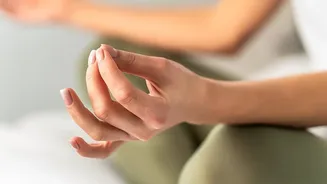
The Hakini Mudra is a sacred hand gesture, or 'mudra', used in yoga and meditation to direct the body's vital life force energy, known as prana. To perform it, you simply bring the palms of your hands to face each other, a few inches apart, and then lightly
touch the tips of all five fingers and the thumb of your right hand to the corresponding fingertips on your left hand. The hands are often held at the level of the chest or raised to the forehead, near the 'third eye'. The term 'Hakini' itself translates from Sanskrit to 'power' or 'rule', signifying the gesture's purpose: to give the practitioner power over their own mind. Often called the 'Mudra for the Mind', it is one of the most well-known gestures for those looking to sharpen their mental faculties.
A Divine Link to the Third Eye
The mudra is named after the Hindu goddess Hakini, who presides over the Ajna chakra, also known as the third-eye chakra. Located in the center of the forehead, this energy center is considered the seat of intuition, intellect, and inner wisdom. According to tantric tradition, Hakini is a powerful Shakti (a form of divine feminine energy) who governs the mind itself. She is often depicted with six faces and seated on a lotus, symbolizing the union of different facets of consciousness. Practicing the Hakini Mudra is believed to invoke the energy of this goddess, helping to activate the third-eye chakra and unlock heightened levels of perception, imagination, and clairvoyance.
Benefits for a Modern Mind
In our fast-paced world, the promises of the Hakini Mudra are more appealing than ever. Its primary benefit is the enhancement of concentration and memory. Practitioners report improved focus, better recall, and greater mental clarity, making it a popular tool for students before an exam or for professionals preparing for a big presentation. The gesture is said to promote cooperation between the right and left hemispheres of the brain, fostering a balance between creativity (often associated with the right brain) and logical thinking (associated with the left brain). This harmonizing effect is also believed to calm the mind, reduce stress and anxiety, and promote clearer, more decisive thinking.
The Science of the Gesture
While rooted in ancient spiritual traditions, the effects of mudras are now being explored through a modern scientific lens. The hands have a vast representation in the brain's sensory and motor cortices. When you perform a mudra, you create a neural circuit that can influence brain activity. Touching the fingertips together stimulates thousands of nerve endings, which in turn activates the brain. Some research suggests that intentional hand gestures can help quiet the Default Mode Network (DMN), a brain network that is active when we ruminate or overthink, thereby anchoring us in the present moment. This connection between the hands and the brain may explain why a simple gesture like the Hakini Mudra can help individuals feel more focused, calm, and mentally energized.