






The Landmark Investment
Eka Robotics, a startup developing intelligent robots with human-like dexterity, announced it has secured a $150 million Series A funding round. The investment was co-led by prominent venture capital firm Andreessen Horowitz (a16z) and F-Prime, with participation
from Samsung Next and others. The substantial funding injection will be used to scale the company's technology and accelerate customer deployments, signalling strong investor confidence in a future where humans and robots collaborate seamlessly on factory and warehouse floors. This move is seen not just as a bet on one company, but as a significant validation of the growing market for collaborative robots, or 'cobots'.
Beyond the Cage: What Are Cobots?
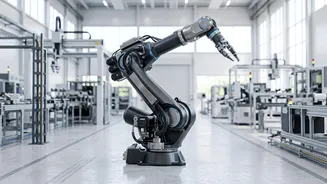
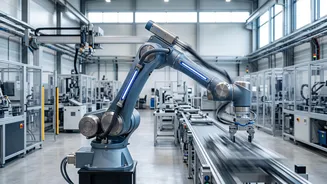
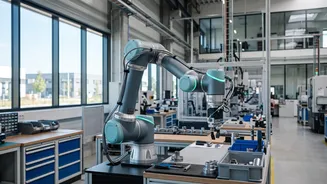
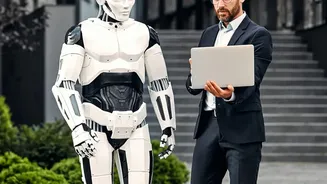
For decades, industrial robots have been powerful but dangerous, confined to cages and separated from human workers to prevent accidents. Cobots are a different breed. Designed from the ground up for safety, they are equipped with advanced sensors, software, and force-feedback systems that allow them to operate alongside people. If a cobot bumps into a person, it is designed to stop or slow its movement to prevent injury. Eka's innovation lies in its 'Vision-Force-Action' (VFA) model, which combines visual perception with a sophisticated sense of touch. This allows their robots to not only see an object but also to feel it, adjusting their grip and motion in real-time to handle delicate or slippery items without crushing them.
Smarter, Faster, and Safer
The core promise of Eka's technology is to bridge the gap between performance and generality. While many robots are programmed to do one specific task well, they often fail when faced with new objects or environments. Eka trains its robots in physics-based simulations, allowing them to gain thousands of hours of experience in minutes and learn to master physics rather than just mimicking human actions. This approach enables Eka's systems to achieve superhuman speeds—the company reports their robots can perform 1,500 picks per hour, more than double the average human rate of 600. This efficiency doesn't come at the expense of safety. By building robots that can intuitively understand and react to their physical environment, Eka aims to drastically reduce workplace accidents in manufacturing and logistics, two sectors where automation is rapidly growing.
A Boost for Indian Industry
This technological leap has significant implications for India's industrial ambitions. As the country aims to become a global manufacturing hub, adopting advanced automation is crucial for enhancing efficiency and competitiveness. The deployment of cobots in factories and warehouses can streamline production lines, improve quality control, and reduce operational costs. More importantly, it can lead to safer working conditions by automating repetitive and ergonomically challenging tasks, freeing up human workers to focus on more complex, high-value roles. The rise of companies like Eka represents a shift from automation that simply replaces labour to one that augments it, potentially creating new job categories for skilled technicians who can manage and maintain these advanced systems.
The Future of Physical Work
Eka's mission extends beyond the factory floor. The same dexterous manipulation technology could one day find applications in healthcare, assisting with delicate procedures; in food service, handling food preparation; or even in households, performing complex chores. The company's founders see this funding as a step toward fundamentally reimagining how physical work gets done globally. By making robots that are not only performant but also general-purpose and safe to interact with, they are laying the groundwork for a future where automation is a collaborative partner in nearly every aspect of our lives. The next major test will be proving these systems can operate reliably for extended periods in real-world industrial settings.