







Beyond the Chatbot: What Is Physical AI?
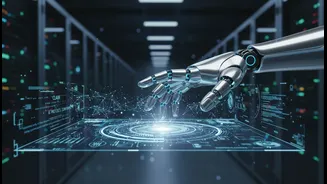
Physical AI refers to artificial intelligence systems that can perceive, reason about, and interact with the physical world. Unlike generative AI models that process text and images in a digital space, physical AI gives machines the ability to sense their
environment through cameras and sensors and then act upon it. This means moving from the realm of bits to the realm of atoms. Instead of generating a sentence, a physical AI might navigate a cluttered room or inspect a piece of machinery. It represents a monumental shift from pre-programmed robots that perform repetitive tasks to autonomous systems that can adapt to dynamic, unstructured environments.
Why Robot Dogs Are the Perfect Embodiment
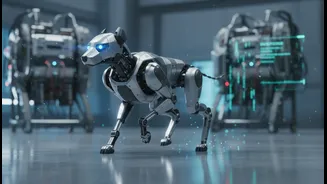
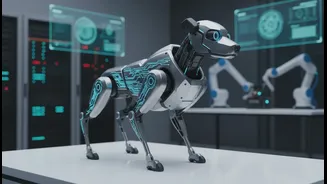
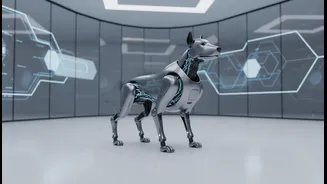
The four-legged robot dog has become the poster child for physical AI for several key reasons. Their legged locomotion allows them to traverse complex terrains—like stairs, slopes, and uneven ground—that are inaccessible to wheeled robots. This mobility makes them ideal for a wide range of real-world applications, from industrial inspection to search and rescue. Furthermore, their form factor is robust and agile, providing a stable platform for sophisticated sensors and, in some cases, a robotic arm for manipulation. Companies like Boston Dynamics have demonstrated how AI models, such as Google's Gemini, can be integrated into their Spot robot, enabling it to perform tasks like tidying a room or even taking a real dog for a walk based on simple commands.
The Technology Behind the Leap
This evolution is powered by breakthroughs in machine learning, particularly reinforcement learning (RL). In this paradigm, an AI agent learns through trial and error, receiving digital "rewards" for successful actions. To make this process safe and efficient, much of the training happens in hyper-realistic simulations. An AI can practice a task millions of times in a virtual world—a concept known as simulation-to-real transfer—before its learned policy is deployed on a physical robot. This allows the robot to develop an intuitive grasp of physics and movement without the costly and time-consuming process of real-world trial and error for every scenario. Recent advances allow AI to continuously adapt even after deployment, making decisions on the fly.
What This Means for Robotics Teams
The rise of physical AI is transforming the job of a robotics engineer. The focus is shifting from meticulously programming every single movement to designing learning environments and reward functions for an AI. Instead of being just coders, robotics teams are becoming more like trainers. Their goal is to create the conditions under which an AI can teach itself to perform a task effectively and safely. This involves building sophisticated simulations, curating training data, and fine-tuning the AI's learning process. The result is a faster, more scalable way to develop complex robotic behaviors that were previously too difficult to engineer by hand. This new workflow streamlines development and allows for the creation of robots that can generalize their skills to new, unseen situations.
How It Will Change Our Interaction with AI
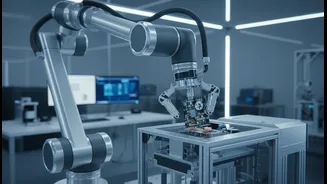
For AI users, this shift means that our interactions with artificial intelligence will no longer be confined to a keyboard or microphone. In the near future, we may interact with AI as a physical collaborator. Instead of typing a request, you might give a verbal command to a robot that can understand your intent and execute a complex physical task. This is already happening in industrial settings, where robots inspect equipment and alert human counterparts to issues. As the technology matures and costs decrease, these applications could move into our homes and public spaces, from assisting the elderly to performing household chores. The human-robot partnership becomes more intuitive, adaptive, and centered on collaboration in a shared physical space.