






The Making of the Golden City
Jaisalmer's moniker, the 'Golden City', is no mere poetic exaggeration; it's a literal description. The entire city, from the monumental Jaisalmer Fort to the intricate havelis (traditional mansions), is constructed from a locally quarried yellow sandstone.
This specific building material gives the city its uniform, honey-hued appearance. As the sun journeys across the sky, the colour of the city transforms. In the soft light of dawn and dusk, the stone walls radiate a warm, honey-gold glow, while under the harsh midday sun, they take on a lighter, tawny lion colour, effectively camouflaging the city against the desert landscape. This mesmerizing play of light on stone is what creates the iconic golden spectacle that has captivated travellers for centuries.
A Gift From the Jurassic Age
The star of this architectural show is the Jaisalmer sandstone itself. Geologically, it belongs to the Jaisalmer Formation, a sedimentary sequence that dates back to the Middle Jurassic period, roughly 160 million years ago. The stone is primarily composed of fine quartz grains cemented by calcium carbonate and, crucially, iron oxides. It is the specific concentration of these iron oxides—limonite and goethite—that imparts the stone's characteristic golden-yellow hue. Quarried from mines in the Jaisalmer district, this stone is not only beautiful but also remarkably practical. It is durable, weather-resistant, and has a relatively low porosity, which helps it withstand the harsh desert climate. In fact, some say the stone hardens over time rather than eroding.
Architecture Carved From Gold
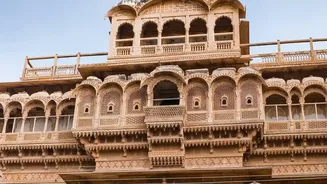
The use of yellow sandstone was a natural choice for builders in Jaisalmer, given its local abundance. The city's founder, Rawal Jaisal, established the magnificent Jaisalmer Fort in 1156 AD on Trikuta Hill, using this very stone. For centuries, the fort was the city. Inside its massive walls, a blend of Rajput and Mughal architectural styles can be seen in the palaces, temples, and havelis. Artisans, using manual tools, painstakingly chiselled the sandstone into incredibly detailed facades, jharokhas (projecting balconies), and delicate 'jali' lattice screens that look almost like lace. This intricate craftsmanship wasn't just decorative; features like jalis were a clever adaptation, allowing for air circulation while maintaining privacy in the desert heat.
The Havelis: Monuments to Merchant Wealth
Beyond the fort, the city's wealthy merchants, who prospered from Jaisalmer's position on ancient trade routes, commissioned their own grand residences. These havelis are some of the finest examples of the city's sandstone architecture. Among the most famous is the Patwon Ki Haveli, which is not a single building but a cluster of five smaller havelis built by Guman Chand Patwa for his sons in the early 19th century. Its ornate walls, countless balconies, and intricate carvings showcase the heights of architectural extravagance that merchant wealth could achieve. Other notable examples, like Salim Singh Ki Haveli and Nathmal Ki Haveli, each display unique designs, from a peacock-shaped upper floor to facades built by two brothers in a competitive feat of artistry.
A Living Heritage of Stone
What makes Jaisalmer truly unique is that its golden architecture is not a sterile relic of the past. The Jaisalmer Fort is one of the few 'living forts' in the world, with about a quarter of the old city's population still residing within its walls. The havelis, too, are often still inhabited by the descendants of the families who built them. This means the golden city is a breathing, evolving community, where daily life unfolds against a backdrop of centuries-old sandstone. The stone is not just a building material; it is the foundation of Jaisalmer's identity, history, and living culture, continuously shaped by the hands of its people and the desert sun.