



Tiny Clues, Big Picture
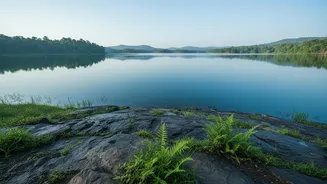
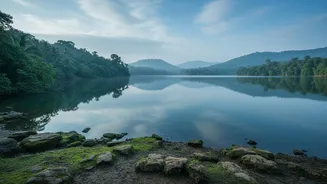
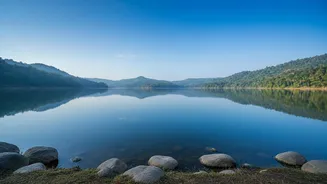
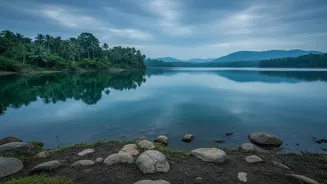
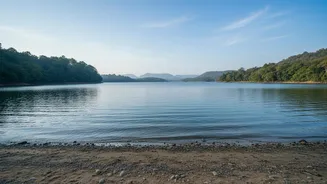
In the heart of India's Core Monsoon Zone, scientists have been playing climate detective. Their investigation site is Raja Rani Lake in Chhattisgarh's Korba district. By drilling down and extracting a 40-centimetre-long core of sediment, researchers
have obtained a remarkable, layered history of the region's environment stretching back some 2,500 years. Within this mud lie the microscopic, yet incredibly durable, pollen grains shed by plants that lived centuries ago. This science, known as palynology, allows researchers to reconstruct what the landscape looked like, and by extension, what the climate was doing.
Reading the Pollen Record
Think of pollen grains as tiny, resilient fingerprints left behind by ancient vegetation. Different plants produce uniquely shaped pollen, and these grains can survive for millennia when preserved in lakebeds. Scientists from the Birbal Sahni Institute of Palaeosciences (BSIP) in Lucknow meticulously analysed these grains. A high concentration of pollen from trees and plants that thrive in wet conditions points to a period of heavy rainfall and lush forests. Conversely, a dominance of pollen from grasses and herbs suggests a drier, more arid environment with less rainfall. This simple but powerful correlation allows scientists to map out wet and dry spells with surprising accuracy.
A Medieval Super-Monsoon
The Chhattisgarh study yielded a startling discovery. The pollen record showed a clear dominance of moist and dry tropical deciduous forest species between roughly 1060 and 1725 CE. This points to a period when Central India was significantly warmer and more humid, experiencing a much stronger and more intense Indian Summer Monsoon (ISM) than previously believed. This era of intensified rainfall corresponds with a global climate phase known as the Medieval Climate Anomaly (MCA), a time when many parts of the world experienced unusually warm temperatures. The study found no evidence of contrasting dry periods within this long phase, suggesting the monsoon was not only strong but also sustained.
Global Forces, Local Impact
What drove this medieval mega-monsoon? The study attributes it to a combination of global and regional factors. These likely included La Niña-like conditions in the Pacific Ocean, which are typically associated with stronger monsoons in India. Other contributing factors may have been a northward shift of the Inter Tropical Convergence Zone (ITCZ), a band of low pressure that governs rainfall patterns, along with increased solar activity during the period. Understanding this complex interplay of forces is key to grasping the full range of the monsoon's natural variability.
Why The Past Matters Now
This research is more than just a fascinating history lesson. By reconstructing the monsoon's behaviour during past climate shifts, scientists can build more robust and accurate models to predict its future. As the world faces modern, human-induced climate change, the question of how the monsoon will respond is one of the most critical challenges facing India. It impacts everything from agriculture and water security to economic stability and the daily lives of millions. Knowing that the monsoon system is capable of such dramatic shifts—as evidenced by the medieval period—underscores the urgency of understanding and preparing for future changes.