



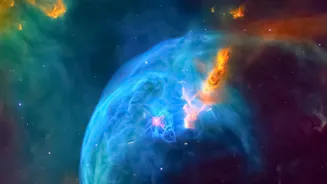
A New Look at a Celestial Favorite
Located about 650 light-years away in the constellation Aquarius, the Helix Nebula is one of the most famous and closest examples of a planetary nebula. This celestial structure has nothing to do with planets; the name is a holdover from when early astronomers
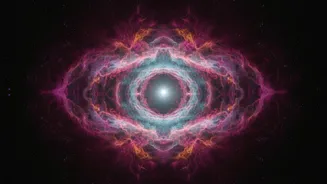
thought their round shapes resembled planets through small telescopes. In reality, it’s the spectacular death shroud of a star once like our own sun. For centuries, astronomers have pointed their telescopes at this object, often nicknamed the "Eye of God" for its appearance in wider views. As the star at its center died, it shed its outer layers of gas and dust, which expanded into space to form the intricate, glowing structure we see. At its heart lies a white dwarf, the super-dense core left behind.
What Are These 'Comet-Like Pillars'?
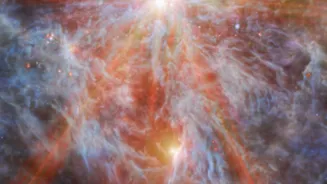
While previous images from telescopes like Hubble have hinted at their existence, Webb's new infrared view brings these features into stunning focus. The image reveals at least 40,000 of these structures, which scientists have dubbed "cometary knots" because of their appearance. Each one has a dense, glowing head and a long, faint tail streaming away from the nebula's central star. But despite the name, they are not comets. They are enormous clumps of gas and dust. The head of a single knot can be twice the size of our entire solar system, with tails stretching for 100 billion miles. While they look tiny in the image, each knot contains about as much mass as the Earth.
A Story Written by Stellar Winds
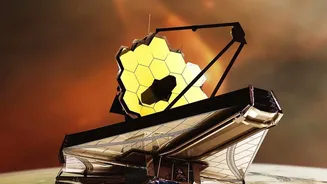
So, if they aren't comets, what created them? The answer lies in a violent cosmic collision. The dying star at the nebula's center is incredibly hot, unleashing fierce stellar winds of gas that race outwards. These winds are crashing into cooler, denser gas that the star ejected thousands of years earlier. The dense, cool clumps of gas are more resilient and resist being blown away. As the hot, fast wind streams past them, it erodes their surfaces, creating the long tails that point away from the central star like windsocks in a hurricane. Webb’s infrared camera, NIRCam, is perfectly suited to see this process in action, cutting through the gas and dust to reveal these structures in unprecedented detail.
Why This Discovery Matters
This spectacular image is more than just cosmic eye candy. The origins of these cometary knots have been a long-standing puzzle for astronomers. By studying them in such detail, scientists can better understand the final, chaotic stages of a sun-like star's life. This process is a preview of our own sun's eventual fate, billions of years from now. Furthermore, these nebulae are cosmic recycling plants. The dying star is seeding the surrounding space with heavier elements forged inside it during its lifetime. These elements, scattered by the stellar winds and contained within these knots, will eventually form new stars and planets. Webb’s observations provide a direct look at how the building blocks of future worlds are distributed back into the galaxy, helping us piece together the story of cosmic creation and our own origins.