
A New Cosmic Portrait
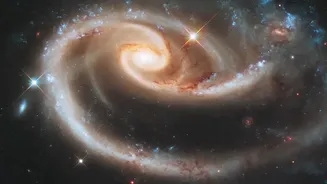
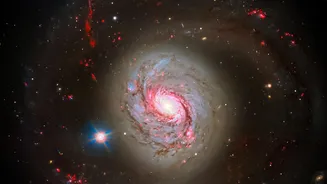
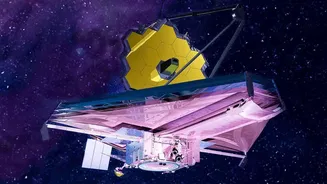
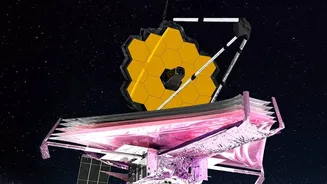
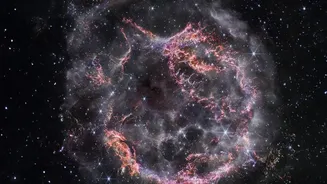
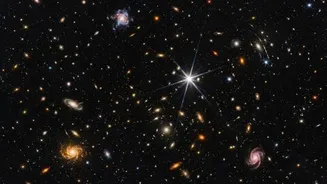
Astronomers are buzzing with excitement over a new batch of images that provide an unprecedented look into the chaos and beauty of galaxy evolution. These new observations, primarily from the James Webb Space Telescope (JWST), are not just pretty pictures;
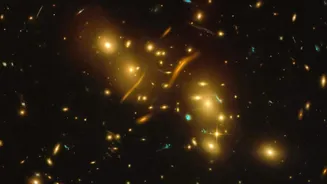
they are scientific treasure troves. One of the most breathtaking new views is of a distant galaxy cluster known as MACS J0553, captured as it was 4.4 billion years in the past. The image reveals a cosmic construction site where two sub-clusters are actively merging. This allows scientists to study the process of galaxy cluster formation in its early stages, providing a live-action look at how the largest structures in the universe are built. It’s like having a time machine that lets us witness the universe’s own version of urban development.
Peering Through the Dust
One of the James Webb telescope's superpowers is its ability to see in infrared light, allowing it to pierce through the thick clouds of cosmic dust that have long hidden celestial secrets. Recent images have put this capability on full display. In a stunning view of Centaurus A, a galaxy shaped by a past collision, Webb's mid-infrared instrument unveiled the dusty structures and hidden activity within. This allows astronomers to trace the flow of gas and dust that fuels intense star formation and feeds the supermassive black hole at the galaxy's core. By studying nearby galaxies like this, which have characteristics similar to those in the early universe, scientists can understand the processes that filled the cosmos with the first generations of stars and heavy elements. It's like finding a local blueprint that helps explain ancient global architecture.
Challenging Our Understanding
These new images are doing more than just confirming old theories; they're actively challenging them. For years, models of the early universe predicted that the first galaxies would be relatively small and simple. However, the JWST keeps finding massive, bright, and structurally complex galaxies from a time when the universe was just a few hundred million years old. Some of these ancient galaxies are surprisingly luminous and already contain heavier elements like nitrogen, which scientists did not expect to see so early. These discoveries are forcing astronomers to go back to the drawing board and rethink how quickly galaxies could form and grow after the Big Bang. The universe, it seems, was in more of a hurry than anyone predicted.
The Power of Collaboration
While the James Webb telescope often grabs the headlines, many of these groundbreaking discoveries are the result of collaboration between multiple observatories. For instance, a recent image of the Black Eye Galaxy (Messier 64) combined data from both the JWST and the Hubble Space Telescope. Hubble captured the galaxy in visible and ultraviolet light, while Webb provided the crucial near- and mid-infrared view. Together, they paint a complete picture of a galaxy with bizarre internal motion, likely the result of a past merger. A recent discovery of a stellar-mass black hole also relied on archival data from Hubble with supporting observations from Webb. This teamwork highlights how different telescopes, each with its own unique strengths, work together to expand our cosmic horizons. No single observatory can tell the whole story.