


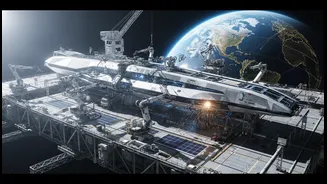



The End of an Era
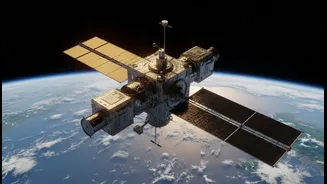
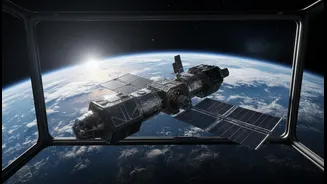
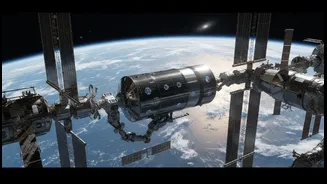
For over two decades, the International Space Station (ISS) has been a beacon of human collaboration and scientific discovery, maintaining a continuous human presence in space. But all journeys must end. The celebrated station is scheduled to be decommissioned
around 2030. Its final act will be a controlled deorbit, guiding the massive structure to a fiery reentry over a remote patch of the Pacific Ocean. Its retirement marks the end of a chapter where government agencies exclusively owned and operated humanity's homes in orbit, presenting NASA with a critical challenge: how to ensure American astronauts continue to live and work in space without a gap.
NASA's New Job: From Landlord to Tenant
Rather than build a costly ISS 2.0, NASA is pivoting its strategy. The agency wants to transition from being an owner and operator to becoming a customer. The plan is to foster a competitive commercial marketplace where private companies design, build, and run their own space stations. NASA would then buy services, like crew time and research access, from these commercial providers. This model, which follows the success of contracting companies like SpaceX to fly cargo and astronauts to the ISS, is designed to lower costs for the taxpayer, stimulate a robust LEO economy, and free up NASA's resources to focus on more ambitious deep-space missions, such as those to the Moon and Mars under the Artemis program.
A Call to the Commercial Sector
To make this vision a reality, NASA has formally asked for the private sector's help. In early July 2026, the agency released a draft Request for Proposals (RFP), inviting American companies to provide feedback and ultimately bid on contracts to develop these future Commercial LEO Destinations (CLDs). This isn't just a casual suggestion box; it's a formal process to shape the acquisition strategy for the successors to the ISS. NASA is asking companies to weigh in on the requirements, timelines, and contractual structures that will define this new public-private partnership in orbit. The feedback period is short and an industry briefing is scheduled, signaling the urgency of the transition.
The High-Stakes Business Case
The path forward recently saw some drama. Earlier in 2026, NASA had briefly considered a different approach, floating the idea of building a government-owned 'core module' for commercial partners to use. This was born from concerns that the business case for purely private stations wasn't yet strong enough. However, the commercial space industry pushed back, arguing that a viable market does exist and that they are ready to invest and build, provided NASA commits to being a reliable anchor customer. After listening to this feedback, NASA reversed course and recommitted to its original plan of purchasing services from independent, free-flying commercial stations. This recent RFP solidifies that decision, boosting industry confidence.
Who Will Build the Future?
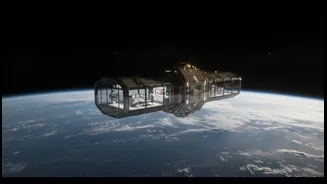
Several ambitious companies are already vying to become the new landlords of LEO. Firms like Axiom Space, which has already flown private astronaut missions to the ISS, plan to first attach modules to the station before detaching to form their own independent outpost. Other major players include Vast, and a joint venture between Voyager Space and Airbus on a station named Starlab. These companies have invested significant private capital and are developing everything from inflatable habitats to modular 'business parks' in space. NASA's approach involves awarding contracts to two or more companies for initial development to encourage competition and redundancy, before selecting one or more for final certification to host its astronauts.