




The Sun’s Hidden Temper
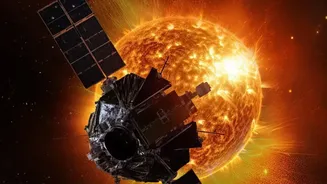
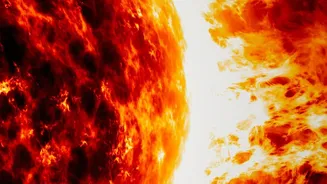
Deep within the Sun's fiery atmosphere, magnetic fields twist and snap, unleashing colossal explosions known as solar flares and coronal mass ejections (CMEs). A CME is a massive bubble of plasma and magnetic fields ejected from the Sun's corona, weighing
billions of tons and travelling at speeds up to 3,000 kilometres per second. When these eruptions are aimed at Earth, they can trigger geomagnetic storms—major disturbances in our planet’s magnetic field. While we are protected on the ground by our atmosphere, our technological infrastructure is not so lucky. These events are more frequent during the peak of the Sun's 11-year cycle.
A Threat to Our Digital World
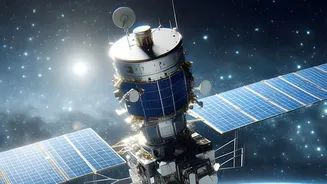
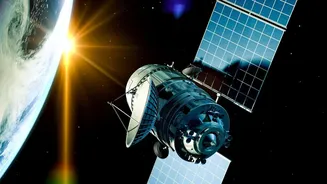
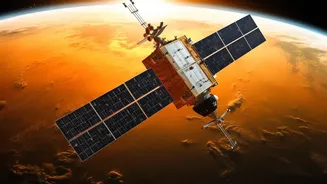
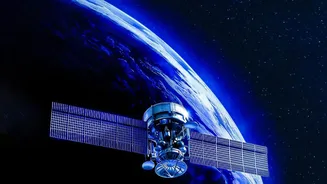
Our global economy runs on systems highly vulnerable to space weather. For satellites orbiting outside the Earth's protective atmosphere, the threat is twofold. Energetic particles can damage sensitive electronics and degrade solar panels, while the swelling of Earth's upper atmosphere during a storm increases drag, causing satellites to lose altitude. On the ground, the danger is just as real. Geomagnetic storms can induce powerful electrical currents in long conductors like power lines and pipelines. These currents can overwhelm transformers and other critical components, leading to widespread and long-lasting power outages. A severe solar storm could cost the economy billions of dollars per day in direct damages and supply chain disruptions.
The Art of Solar Forecasting
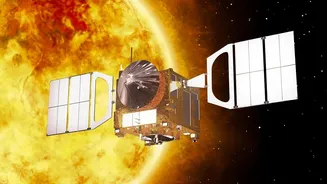
Protecting these vital assets starts with prediction. A fleet of spacecraft, operated by agencies like NASA, NOAA, and ESA, constantly monitors the Sun. Observatories like the Solar and Heliospheric Observatory (SOHO) use instruments called coronagraphs, which block the Sun's blinding glare to watch for CMEs as they erupt from the corona. By analysing the speed and trajectory of a CME, scientists can forecast its potential arrival time and impact on Earth. This data gives satellite operators and power grid managers crucial lead time—from hours to a few days—to prepare. Recently, artificial intelligence models like 'EarlyDetect' have shown promise in identifying the hidden magnetic precursors to solar active regions hours before they even become visible, offering an even earlier warning.
India’s Eye on the Sun
India has emerged as a key player in the global effort to monitor space weather with its Aditya-L1 mission. Positioned at the L1 Lagrange point, about 1.5 million kilometres from Earth, Aditya-L1 has an uninterrupted view of the Sun. Its suite of seven instruments observes the Sun's atmosphere across different wavelengths, providing critical data on the dynamics of CMEs and the solar wind. The mission has already provided groundbreaking insights, helping scientists to understand the complex magnetic interactions within solar storms as they travel toward Earth. Aditya-L1's contributions are vital for improving space weather models and safeguarding India's own growing fleet of satellites and digital infrastructure.
From Prediction to Protection
An early warning is only useful if action is taken. When a potentially damaging solar storm is detected, satellite operators can put their spacecraft into a safe mode, powering down sensitive electronics to prevent them from being fried by charged particles. They can also make orbital adjustments to counteract increased atmospheric drag. Protective measures include robust shielding for internal components, sometimes using layers of materials like aluminum or even gold foil to block radiation. For power grid operators, a forecast allows them to re-route power, take vulnerable equipment offline, and prepare repair crews. This proactive approach helps to mitigate the worst effects of a storm, ensuring that a blast from the Sun doesn't send our hyper-connected world back to the dark ages. The continuous tracking of these cosmic events is an invisible shield that keeps our modern society running safely.