

The Universe’s Messy Youth
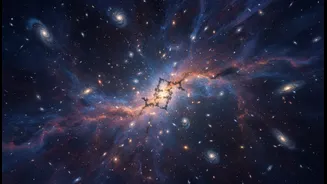
For decades, the standard model of cosmology told a compelling story about how galaxies came to be. In the aftermath of the Big Bang, the universe was a turbulent, frenetic place. The theory, known as the hierarchical model, proposed that massive galaxies like
our own Milky Way were built from the ground up. Over billions of years, small, irregular clumps of gas and dark matter would violently collide and merge, gradually assembling into the grand, structured galaxies we see today. According to this script, the earliest galaxies should look like cosmic “train wrecks”—chaotic, clumpy, and lacking any defined structure. Finding a well-ordered galaxy in the early universe was considered highly improbable.
A Glimpse of Unexpected Order
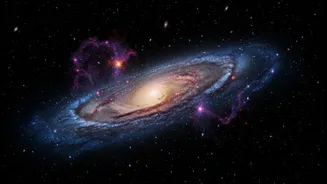
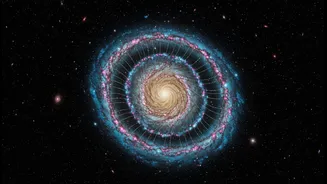
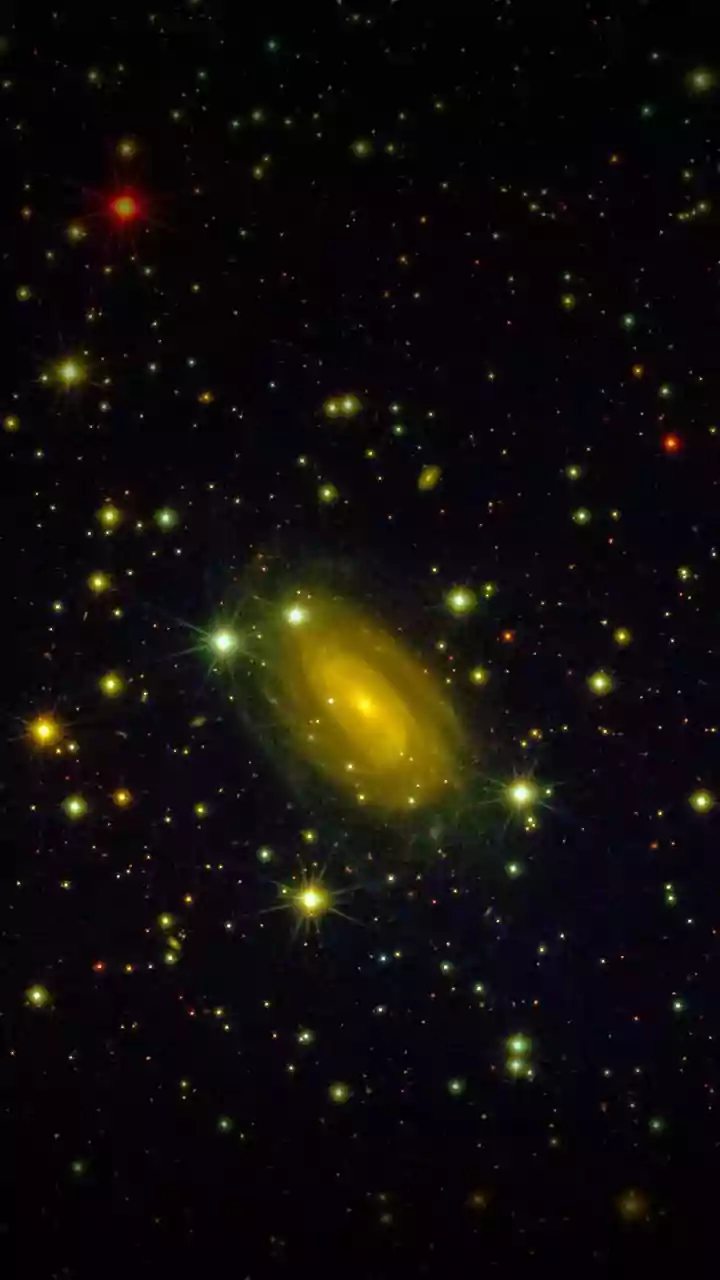
This long-held assumption is now being challenged by powerful new observations. Using the James Webb Space Telescope (JWST), astronomers are peering deeper into cosmic history than ever before, and what they are finding is astonishing. Multiple studies have identified galaxies from when the universe was just a few billion years old that display a remarkable degree of organisation. One prominent example is a galaxy named CEERS-2112, which was observed as it existed when the universe was only about two billion years old. It shows a clear bar-like structure in its centre, a feature common in mature galaxies like the Milky Way but thought to be impossible so early on.
The Telltale Signs of Structure
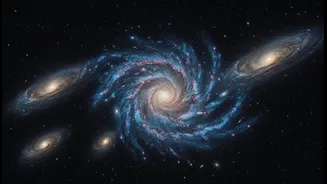
So, what does it mean for a galaxy to be “organised” at such a young age? It's about structure and stability. Instead of being messy collections of stars, these ancient galaxies show signs of being rotating disks. The discovery of CEERS-2112 was particularly shocking because of its stellar bar. A bar is a dense, elongated structure of stars in a galaxy's centre that acts like a cosmic conveyor belt, funnelling gas and dust inward to fuel star formation and potentially feed a central supermassive black hole. The formation of a stable bar was thought to take billions of years of galactic evolution. Finding one so early suggests that galaxies matured much faster than previously believed.
A New Eye on the Cosmos
These groundbreaking discoveries would not be possible without the James Webb Space Telescope. Launched in late 2021, the JWST is the most powerful space observatory ever built. Its ability to detect faint infrared light is crucial for studying the early universe. As light from the most distant galaxies travels across the expanding universe, its wavelength is stretched out, shifting it from the visible spectrum into the infrared. Webb’s giant mirror and sensitive instruments are specifically designed to capture this ancient light, allowing scientists to effectively look back in time and see galaxies as they were over 13 billion years ago. It has found not just one, but numerous examples of well-ordered and massive early galaxies, fundamentally changing our dataset.
Rewriting the Cosmic Storybook
The existence of these organised structures doesn't completely break our understanding of physics, but it does demand a major revision of our theories on galaxy formation. The standard hierarchical model, with its emphasis on violent mergers, cannot easily explain how a delicate, ordered disk could form so quickly and survive. Scientists are now exploring alternative or supplementary theories. One idea is that some galaxies grow through a smoother process called “cold accretion,” where they draw in steady streams of cold gas from cosmic filaments, allowing a stable disk to build up rapidly. These new findings force theorists back to the drawing board to develop models that can account for both chaotic mergers and this new evidence of rapid, orderly growth.