



Understanding Core Stability
Before diving into the water, let's clarify what 'core stability' really means. It's not just about having a visible six-pack. Your core is a complex group of muscles that wraps around your entire trunk, including your abdominals, obliques on your sides,
and the muscles in your lower back. A strong core acts as a stable base for your body, allowing you to generate power, maintain balance, and transfer force efficiently through your arms and legs. Training on an unstable surface, like a floating board, forces these muscles to work harder, constantly making micro-adjustments to keep you upright. This enhances your body’s ability to sense its position in space, a skill known as proprioception.
Paddleboarding: A Full-Body Balancing Act
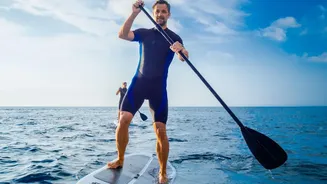
Stand-up paddleboarding is, at its heart, an exercise in dynamic balance. Simply standing on the board forces your body to instinctively recruit stabilizer muscles in your core, hips, and legs to adapt to the shifting water beneath you. Every small ripple and every paddle stroke requires your abs, obliques, and lower back to contract to keep you from toppling over. This creates a constant, low-level engagement that builds exceptional endurance and stability. It's a full-body workout where your leg muscles work to grip the board, while your core provides the solid platform needed to pull the paddle through the water, engaging your back and shoulder muscles.
Kayaking: The Power of Rotational Force
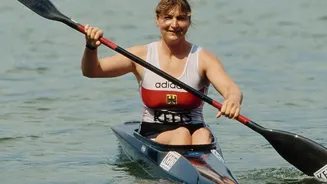
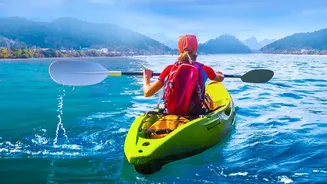
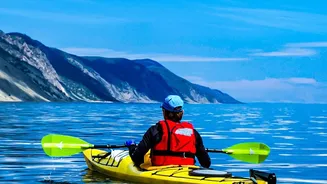
While you're sitting down in a kayak, don't assume your core is taking a break. In fact, effective kayaking technique is driven almost entirely by the core. The power for each paddle stroke should come from twisting your torso, not pulling with your arms. This rotational movement heavily engages the obliques, the muscles on the sides of your waist, as well as the abdominals and lower back. As you pull the paddle blade through the water, you are essentially performing a seated rotational exercise, similar to a Russian twist. This builds powerful, dynamic core strength, crucial for propelling the boat forward efficiently and controlling its movement.
A Tale of Two Cores: The Direct Comparison
So, how do they stack up? Paddleboarding is fundamentally a challenge of anti-rotation and stability endurance. Your core is constantly working to resist movement and keep you balanced over the board’s center of gravity. It’s an isometric and stabilization-focused workout. Kayaking, on the other hand, is about generating rotational power. Your core is the engine, actively twisting and contracting to create the force for each stroke. While kayaking does require balance to keep the boat upright, the primary demand on the core is for power generation, not just stabilization. Paddleboarding builds a foundation of unwavering stability; kayaking builds the strength to move with powerful rotation.
Which Is Right For Your Fitness Goals?
The best choice depends entirely on what you want to achieve. If your goal is to improve your overall balance, posture, and the deep stabilizing muscles that protect your spine, paddleboarding is an excellent option. It’s a low-impact, full-body workout that builds functional strength from the ground up. If you're looking to build explosive, rotational power and really target your obliques for a strong, toned waistline, kayaking offers a more focused and intense workout for those specific muscles. It provides a fantastic upper body and cardio workout, with core rotation at its heart.