






Sailing on Sunlight
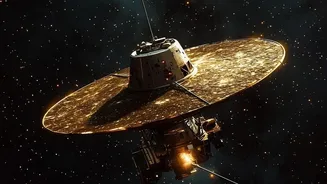
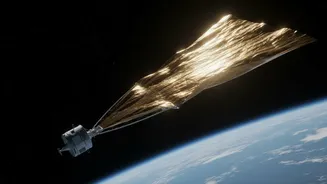
At its core, a solar sail works much like a sailboat using wind, but in the vacuum of space, the 'wind' is sunlight itself. Sunlight is made of particles called photons. While they have no mass, they have momentum. When these photons bounce off a large,
reflective surface — the sail — they transfer that momentum, giving the spacecraft a tiny but continuous push. Unlike a chemical rocket that provides a powerful burst of thrust for a short time and then coasts, a solar sail provides constant acceleration. Over weeks and months, a solar-sail-powered spacecraft can achieve incredible speeds, all without carrying heavy propellant.
The 'Ultra-Thin' Advantage
For a solar sail, performance is a simple equation: the less mass you have to push, the faster you can accelerate. This is where the 'ultra-thin' aspect becomes critical. Early sails were made from materials like Mylar, but today's research focuses on advanced composites and even materials as thin as graphene, which is only one atom thick. The lighter and thinner the sail material, the greater the thrust-to-mass ratio. This allows for much larger sails that can be packed into a small volume for launch, a key factor in reducing mission costs. NASA's Advanced Composite Solar Sail System (ACS3), for example, uses lightweight composite booms that are lighter and more stable than previous metal versions, enabling much larger sails for future missions.
A New Paradigm of Efficiency
The primary limitation of deep-space travel is the tyranny of the rocket equation. To go faster or further with a chemical rocket, you need more fuel. But more fuel adds more mass, which in turn requires even more fuel to launch. This cycle dramatically limits the range and duration of missions. Solar sails break this cycle entirely. Since their 'fuel' is ubiquitous sunlight, their operational lifetime is only limited by the durability of the sail materials and electronics. This propellant-free propulsion enables missions that would be prohibitively expensive or time-consuming with conventional rockets, such as maintaining a stationary position in a non-Keplerian orbit or sending probes to the outer solar system and beyond.
Unlocking the Solar System and Beyond
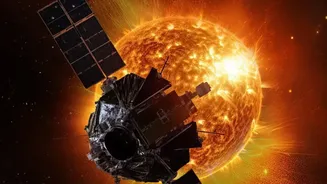
The efficiency of ultra-thin solar sails opens up a new frontier of scientific possibilities. Missions that currently take years, like reaching the outer planets, could be completed in a fraction of the time. Some concepts propose using a solar sail to perform a 'slingshot' maneuver close to the sun, which could accelerate a spacecraft to speeds 20 times faster than the Voyager 1 probe. This would allow a probe to reach Jupiter in months or even send a craft to the solar gravity lens, a key location for astronomical observation, in under a decade. Agencies like NASA and NOAA are actively developing this technology for missions ranging from better space weather prediction to exploring near-Earth asteroids and eventually, interstellar space.