

Patra: The Savoury Colocasia Leaf Rolls
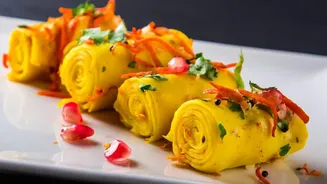
Found across India's western coast, patra, also known as alu vadi, stars the humble colocasia (arbi) leaf. These large, heart-shaped leaves have a distinct, earthy flavour. To make patra, the leaves are smeared with a spiced gram flour (besan) paste,
which is often tangy with tamarind and sweet with jaggery, then rolled, steamed, and sliced. The resulting pinwheels can be tempered with mustard seeds and sesame or pan-fried until crisp. It’s a brilliant transformation of a simple leaf into a complex, layered snack that is both low-calorie and flavourful.
Vazhaithandu Poriyal: The Fibrous Banana Stem Stir-Fry
While bananas are a staple, their stem (vazhaithandu in Tamil, vazhapindi in Malayalam) is often ignored. This highly fibrous ingredient, prized in South Indian cuisine for its health benefits, has a mild taste and a satisfyingly crunchy texture. Preparing it involves slicing the inner core into discs and removing the coarse fibres. A classic vazhaithandu poriyal is a simple stir-fry where the finely chopped stem is cooked with a tempering of mustard seeds, lentils, curry leaves, and a generous garnish of grated coconut. It’s a refreshing and light side dish, often served with rice.
Kathal Ke Beej Ki Sabzi: The Meaty Jackfruit Seed Curry
After savouring sweet jackfruit, don't discard the seeds! These large seeds, known as 'palakottai' in Tamil, have a nutty flavour and a texture often compared to chestnuts or potatoes. In many Indian homes, particularly in the south, they are boiled, peeled, and turned into delicious curries. A typical kathal ke beej ki sabzi involves cooking the boiled seeds in a flavourful onion-tomato gravy, spiced with ginger, garlic, and traditional masalas. The seeds absorb the curry's flavours beautifully, making for a hearty, protein-rich dish that proves nose-to-tail eating isn't just for meat.
Moringa Phool Sabzi: The Delicate Drumstick Flower Dish
Most are familiar with the drumstick vegetable, but its delicate white flowers, known as 'sahjan ke phool', are also edible and delicious. Popular in Eastern India, these flowers have a subtle, unique flavour, though they possess a slight bitterness that needs to be treated by boiling them briefly before cooking. A common preparation is a simple sabzi where the boiled flowers are stir-fried with ingredients like potatoes, peas, and a light tomato-onion masala. It's a seasonal delicacy packed with nutrients, showcasing a part of the plant many overlook.
Dagad Phool: The Secret of Goda Masala
This ingredient is more of a secret agent in your spice box. Dagad phool, or stone flower, is a type of lichen that grows on rocks and trees. In its raw state, it has almost no fragrance. However, when heated in oil or ghee, it releases a deep, earthy, and smoky aroma that is irreplaceable. It is a crucial, though often unrecognised, component in spice blends like Maharashtrian Goda Masala and Chettinad masalas. While you might not cook with it on its own, knowing its role helps you understand the complex backbone of some of India’s most aromatic dishes, including biryani and nihari.
Ambadi Bhaji: The Tangy Roselle Leaf Curry
Known as 'gongura' in Andhra Pradesh and 'ambadi' in Maharashtra, roselle leaves are celebrated for their distinctively sour taste. While a staple in certain regions, they are often overlooked elsewhere. These green leaves are used to make tangy dals, pickles, and chutneys. A classic Maharashtrian Ambadi Bhaji involves cooking the leaves with lentils like toor or chana dal, peanuts, and a touch of jaggery to balance the sourness. Tempered with garlic and spices, the resulting dish is a thick, flavourful curry that pairs perfectly with jowar or bajra bhakri.
Nadru Yakhni: The Crisp and Tender Lotus Stem
Kamal kakdi, or lotus stem, is known for its beautiful, lace-like pattern when sliced and its delightful crunch. While it appears in some stir-fries and pickles, its potential is often underutilised. A star dish from Kashmiri cuisine, Nadru Yakhni, showcases the lotus stem's ability to absorb flavour while retaining its texture. In this preparation, thick slices of lotus stem are gently simmered in a fragrant, creamy yogurt-based gravy seasoned with spices like fennel and ginger powder. The result is a sophisticated, mellow curry that is utterly unique and comforting.
Hokh Syun: Kashmiri Sun-Dried Vegetable Curry
In the harsh winters of Kashmir, when fresh produce is scarce, a traditional wisdom of food preservation shines through in Hokh Syun. This isn't a single ingredient but a category of sun-dried vegetables—from tomatoes and turnips to gourds—preserved during the summer. These dried vegetables are then rehydrated and cooked into a deeply flavourful, often smoky curry. It's a dish born of necessity but cherished for its intense, concentrated taste that is completely different from its fresh counterpart. It’s a beautiful lesson in zero-waste cooking and seasonal eating.