







What Exactly is a Perovskite Solar Cell?
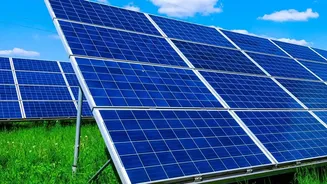
For decades, solar power has meant silicon. Those familiar blue or black panels on rooftops are made from highly purified, sliced silicon wafers. Perovskite solar cells, however, are fundamentally different. Named for their specific crystal structure,
they use hybrid organic-inorganic lead or tin halide-based compounds as the light-harvesting layer. Think of it less like a rigid, brittle wafer and more like a printable ink. These materials can be manufactured at lower temperatures using simpler processes, making them potentially much cheaper and more versatile than their silicon counterparts. This allows them to be made lightweight, flexible, and even semi-transparent, opening a world of possibilities beyond traditional panels.
The Efficiency Breakthroughs Turning Heads
The primary reason for the excitement is a rapid surge in efficiency. In laboratory settings, perovskite-silicon 'tandem' cells, which stack a perovskite layer on top of a traditional silicon cell, have achieved staggering results. By late 2025, researchers had pushed certified efficiency records to over 34%, shattering the theoretical efficiency limit of a standard silicon cell on its own. This tandem approach is incredibly effective because each layer captures a different part of the solar spectrum; the perovskite top cell absorbs high-energy blue and green light, while the silicon bottom cell captures the remaining red and infrared light, converting more of the sun's power into electricity. While lab records for small cells are one thing, the technology is now making the leap to commercial reality. Companies have begun shipping the first commercial-sized tandem modules with impressive efficiencies, proving the technology is no longer just a laboratory curiosity.
The Promise of Lower Costs
The phrase "for all" in the context of solar power hinges on one thing: cost. This is where perovskites have their most significant long-term advantage. Traditional silicon manufacturing is an energy-intensive, high-temperature process requiring highly purified materials. Perovskites, by contrast, can be made from abundant, cheaper raw materials and processed at low temperatures, almost like printing a newspaper. While current, small-scale manufacturing costs are still higher than mass-produced silicon, techno-economic models show a clear path to becoming significantly cheaper. As production scales up and material yields improve, the cost of perovskite modules is projected to fall dramatically, making solar power accessible to a much wider audience.
Hurdles on the Path to Your Rooftop
Despite the incredible promise, perovskite panels are not set to replace silicon overnight. The biggest challenge has been durability. Early perovskite cells degraded quickly when exposed to moisture, heat, and continuous sunlight. However, recent scientific breakthroughs in 2026 are tackling this head-on, with new chemical engineering strategies significantly improving stability. Researchers have developed cells that retain over 95% of their efficiency after thousands of hours of stress testing, clearing a major hurdle for commercial viability. The other challenge is scaling up. Achieving record-breaking efficiency on a tiny, square-centimetre cell in a lab is different from mass-producing large, reliable panels. Limited commercial availability for premium projects is expected through 2026, with mass-market residential adoption likely starting from 2027 onwards as supply chains mature.
India's Role in the Perovskite Revolution
India is not just a bystander in this global energy shift. Premier institutions like the IITs are at the forefront of perovskite research, developing highly efficient cells and tackling stability issues under Indian climate conditions. An IIT-Bombay incubated startup, ART-PV, has already developed a tandem cell with nearly 30% efficiency and is working on setting up a fabrication facility. Furthermore, P3C Technology and Solutions is positioning itself as India's first dedicated perovskite solar cell manufacturer. These efforts align perfectly with national initiatives like "Make in India" and the drive for energy self-reliance, suggesting that the first applications in the country may focus on niche areas like building-integrated photovoltaics and portable power for rural areas before expanding to large-scale solar farms.