

What Is Photon Pressure?
It sounds like science fiction, but the idea is over a century old. Light, while having no mass, is made up of particles called photons that carry momentum. When a photon hits a surface and bounces off, it transfers that momentum, giving the surface a tiny,
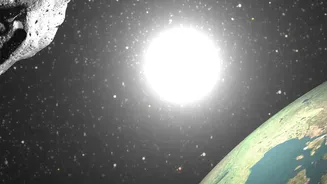
tiny push. In the vacuum of space, with no friction to slow things down, these continuous tiny pushes can add up. It’s not the solar wind, a common misconception, but the pressure of light itself that provides the force. This phenomenon, known as solar radiation pressure or photon pressure, is the principle behind one of space travel's most elegant propulsion concepts.
Harnessing Sunlight with Solar Sails
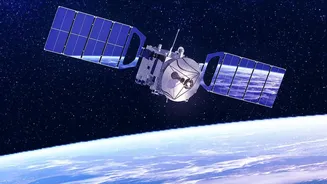
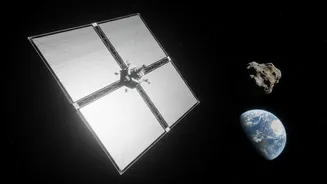
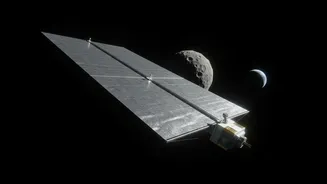
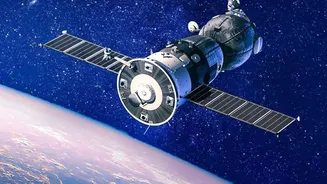
To capture this minuscule force, you need a solar sail. Imagine a massive, ultra-thin, reflective sheet, like a giant kite made of Mylar or other advanced materials, attached to a spacecraft. Unfurled in space, this sail catches photons from the Sun. Unlike a chemical rocket that gets a short, powerful burst of thrust, a solar sail gets a continuous, gentle push. Over weeks and months, this constant acceleration allows the spacecraft to build up tremendous speeds, potentially much greater than what a fuel-limited rocket could achieve. Missions like The Planetary Society's LightSail 2, which successfully used a sail to change its orbit around Earth, have proven the concept is viable.
The Breakthrough: Lighter, Stronger, Smarter
The "breakthrough" isn't a single discovery, but the culmination of several recent advancements that make solar sails more practical than ever. The key is to make sails enormous but incredibly lightweight. NASA's recent ACS3 (Advanced Composite Solar Sail System) mission is testing new composite booms made of lightweight carbon fiber. These new materials will allow future sails to be much larger—up to the size of a basketball court and beyond—without adding prohibitive weight. Combined with increasingly sophisticated navigation systems that allow the craft to tack and steer by changing the sail's angle to the sun, the technology has matured from a novel experiment into a workable propulsion system for ambitious new missions.
Why Asteroids Are the Perfect Target
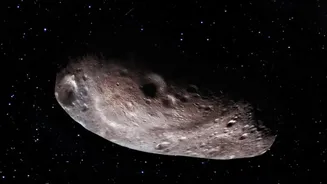
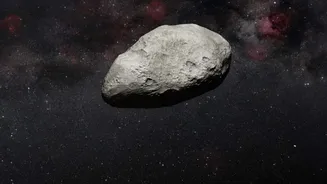
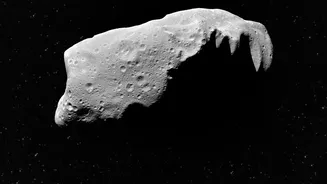
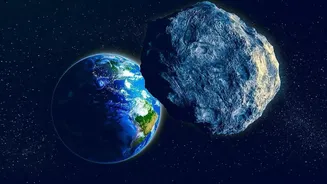
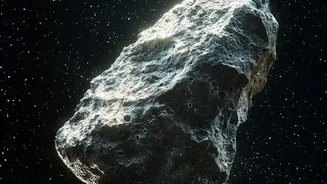
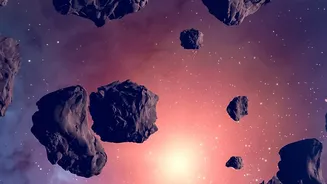
This technology is a game-changer for studying near-Earth asteroids. These objects are often in tricky orbits that would require a conventional probe to carry enormous amounts of fuel for course corrections and rendezvous maneuvers. A solar sail craft, however, can perform these complex orbital ballets with ease. It can use its gentle, continuous thrust to spiral out from Earth, fly by one asteroid, and then adjust its trajectory over time to visit another, and perhaps another after that. This fuel-free mobility opens the door to creating detailed surveys of dozens of asteroids with a single probe, something that would be prohibitively expensive and complex with chemical rockets. Missions like the planned Near-Earth Asteroid (NEA) Scout were designed around this exact capability.
The Future of Fuel-Free Exploration
Studying asteroids is just the beginning. The infinite fuel efficiency of a solar sail makes it ideal for many other applications. They could be used to create stable observation posts for monitoring solar storms, providing earlier warnings for our power grids and satellites. Some have proposed using them to help de-orbit space debris, gently pushing junk into the atmosphere to burn up. And for the truly long-term view, solar sails, perhaps pushed by powerful ground-based lasers, represent one of the most promising technologies for achieving interstellar travel, sending probes to nearby stars. By removing the dependency on heavy, expensive propellant, photon pressure propulsion doesn't just make space exploration cheaper—it makes entirely new kinds of exploration possible.