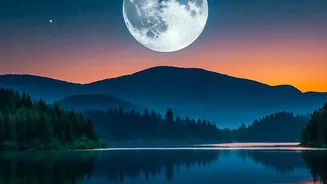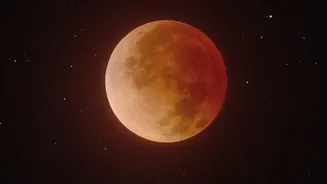




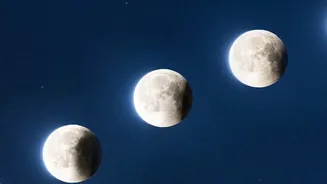
When the Moon turns a coppery red in the night sky, it’s an awe-inspiring sight. Often called a 'Blood Moon', this celestial event isn’t magic, but a beautiful display of physics involving the Sun, Earth, and our own atmosphere.
A Perfect Cosmic Line-Up
First, let's understand
what a total lunar eclipse is. It happens when the Sun, Earth, and Moon align perfectly, with Earth positioned directly between the other two. This alignment causes Earth to cast its shadow over the Moon, which would go completely dark if our planet didn't have an atmosphere. Lunar eclipses only occur during the full moon phase, when the geometry is just right for the Moon to pass through Earth's shadow. This shadow is divided into two parts: the darker, inner shadow called the umbra, and the fainter, outer shadow called the penumbra. For the Moon to turn red, it must pass entirely into the umbra.
Earth's Atmosphere as a Giant Lens
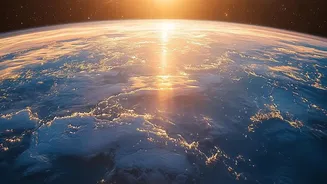
The secret to the red moon lies in Earth's atmosphere. While our planet blocks the Sun's direct light, its atmospheric layer extends beyond the solid surface. As sunlight grazes the edges of Earth, it passes through this thin blanket of air. The atmosphere acts like a lens, bending or refracting the light. Instead of continuing straight into space, this bent light is redirected towards the Moon, dimly illuminating it even when it's deep inside Earth's shadow. So, rather than a blackout, we get a celestial light show.
The Science of a Sunset... on the Moon
The specific reason for the red colour is a phenomenon called Rayleigh scattering. It's the same process that makes our sky appear blue and gives us vibrant red and orange sunsets. Sunlight is made of a spectrum of colours, from violet and blue at one end to orange and red at the other. Shorter wavelengths, like blue and violet, are scattered more easily by the molecules and small particles in Earth's atmosphere. Longer wavelengths, like red and orange, are more resilient and can pass through the atmosphere more directly.
Why Red Gets the Spotlight
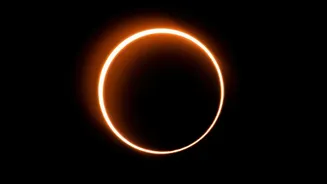
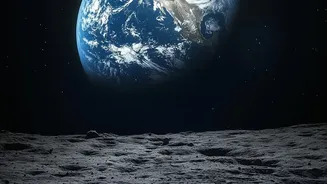
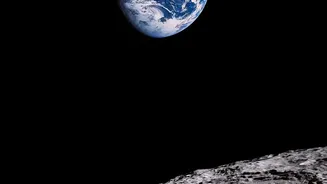
During a lunar eclipse, the sunlight that reaches the Moon has to travel through a very long and dense slice of Earth's atmosphere—essentially through all of the world's sunrises and sunsets at once. As this light makes its long journey, most of the blue and violet light is scattered away, leaving the red and orange light to continue on its path. This remaining reddish light is what gets bent toward the Moon, bathing the lunar surface in a coppery glow that we see from our vantage point. If you were an astronaut standing on the Moon during a total lunar eclipse, you would see a dark Earth surrounded by a brilliant red ring—the light of every sunrise and sunset happening on the planet.
Not All Eclipses Are the Same Shade
The exact shade and brightness of a 'Blood Moon' can vary from one eclipse to another. The colour depends on the state of Earth's atmosphere at the time. If the atmosphere is filled with a lot of dust from volcanic eruptions or clouds, the Moon might appear a much darker, deeper red, or even almost black. A cleaner, clearer atmosphere will result in a brighter, more coppery or orange hue. How centrally the Moon passes through the Earth's umbral shadow also affects the colour; a deeper pass results in a darker eclipse.