



Cosmic Beacons from the Dawn of Time
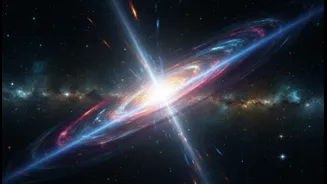
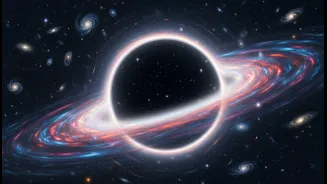
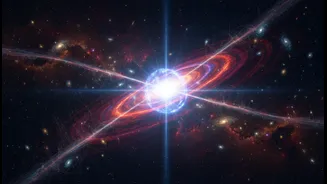
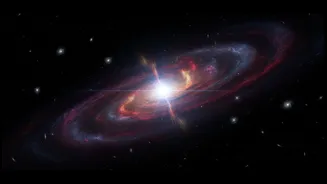
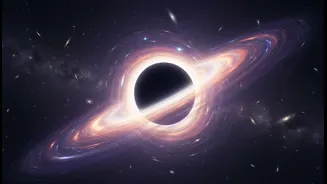
Before we dive into the puzzle, let's get acquainted with the main character: the quasar. A quasar, short for 'quasi-stellar radio source', isn't a star, but it can outshine entire galaxies. It's the intensely bright core of a distant galaxy, powered
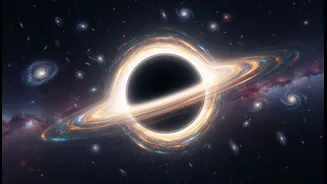
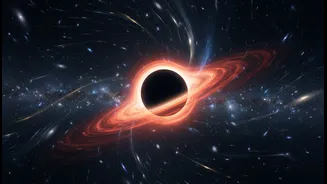
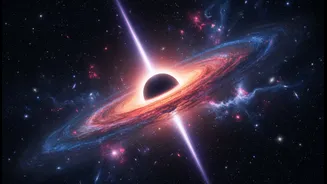
by a supermassive black hole at its centre. As the black hole’s immense gravity pulls in surrounding gas, dust, and stars, the material heats up and glows ferociously, creating a beacon of light that can travel across the universe for more than 13 billion years to reach our telescopes. This makes them invaluable tools for studying the early cosmos; they are cosmic fossils from a time when the universe was young.
The Standard Recipe for a Giant
For a long time, the prevailing theory of how supermassive black holes grow was fairly straightforward, if slow. It starts with a 'seed' black hole, perhaps formed from the collapse of a massive star. This seed then grows over billions of years through a process called accretion, where it steadily feeds on gas and dust from its host galaxy. It can also merge with other black holes when galaxies collide. However, there’s a theoretical speed limit to this growth, known as the Eddington limit. If a black hole consumes matter too quickly, the radiation blasting away from it will push back on the incoming material, effectively choking off its own food supply. This self-regulation means growing a billion-solar-mass black hole should take a very, very long time.
The 'Impossible' Objects
Here's the problem. Recent discoveries, particularly from the powerful JWST, have identified quasars powered by black holes that are a billion times the mass of our Sun when the universe was less than a billion years old. Some have been found existing as early as 670 million years after the Big Bang. These objects simply shouldn't exist according to the standard model. There wasn't enough time for a stellar-mass seed to gradually accrete that much matter, even if it was eating as fast as physically possible under the Eddington limit. It's a major unsolved problem in astrophysics: how did these black holes get so big, so fast?
Rewriting the Cosmic Playbook
This cosmic conundrum has sent theorists back to the drawing board, leading to some fascinating new ideas. One possibility is that black holes can sometimes break the cosmic speed limit. Under certain conditions, a process called 'super-Eddington accretion' might allow a black hole to gorge on material much faster than previously thought. Another idea challenges the starting point. Instead of small seeds from dead stars, perhaps the first black holes were born massive from the get-go. One theory posits the 'direct collapse' of enormous, primordial gas clouds in the early universe, forming black hole seeds already hundreds of thousands of times the mass of the sun. A third, more exotic theory suggests the seeds were primordial black holes forged in the chaotic moments immediately following the Big Bang itself, before the first stars even existed.
A Paradigm Shift in the Making
Some recent findings even suggest that the black hole might come before the galaxy. Astronomers have found ancient, gargantuan black holes that make up an astonishingly large fraction of their host galaxy's total mass, thousands of times greater than the ratio seen in the modern universe. This flips the old script on its head, suggesting that in the early universe, massive black holes may have formed first and served as the gravitational anchors around which the first galaxies then grew. What’s more, some of these ancient quasars appear to be surprisingly lonely, without the densely packed clusters of neighbouring galaxies that models predicted were necessary to provide enough fuel for their rapid growth.