
A Window to the Cosmic Dawn
To understand how the first stars were born, astronomers need a time machine. In a way, they have one. Telescopes like the James Webb Space Telescope (JWST) can capture 'deep field' images by staring at a tiny, seemingly empty patch of sky for hours or even
days. Because light from distant objects takes billions of years to reach us, these long exposures collect the faint, ancient light from the universe's infancy. The result is a stunning portrait not of a single galaxy, but of thousands, some seen as they were just a few hundred million years after the Big Bang. Before JWST, our knowledge of this era, known as the 'cosmic dawn,' was based more on speculation and theory. Now, thanks to the telescope's powerful infrared sensitivity, we can see physical details of these first cosmic structures.
An Unexpectedly Bright Beginning
One of the first surprises from JWST's deep field images was just how bright the earliest galaxies were. According to standard models of cosmology, galaxies should start small and grow steadily over billions of years. These early galaxies, however, appeared far more luminous and mature than expected for their young age, posing a puzzle for astronomers. This unexpected brightness initially suggested they were far more massive than theory predicted, making it difficult to explain how they could have assembled so quickly after the Big Bang. This observation challenged existing models and sent scientists looking for an explanation that could account for such brilliant, ancient light.
The 'Bursty' Nature of Early Stars
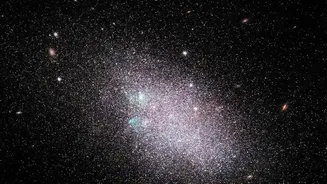
The answer, it seems, lies not in the size of the galaxies, but in the way they formed stars. Instead of a steady, continuous process like in our own Milky Way, new research and advanced computer simulations suggest that early, low-mass galaxies formed stars in intense, rapid bursts. This concept, known as 'bursty' star formation, involves a cycle: a galaxy would rapidly produce a huge number of stars at once, followed by a long, quiet period with very little star birth, before the cycle repeated. These bursts would have made the galaxies flash with incredible brightness, making them appear more massive than they truly were. The phenomenon is particularly common in low-mass galaxies, which were the norm in the early universe.
A Cosmic Cycle of Creation and Destruction
The engine driving this bursty cycle is a dramatic feedback loop. A massive burst of stars forms from the dense gas within a young galaxy. A few million years later, the most massive of these new stars die in powerful explosions called supernovae. These explosions are so violent that they blast gas out of the small, low-gravity galaxy, temporarily halting any further star formation. Over millions of years, that expelled gas cools and is pulled back in by the galaxy's gravity, accumulating until it triggers another intense burst of star creation, starting the cycle anew. In more massive, mature galaxies like our own, gravity is strong enough to hold onto this gas even after supernovae, leading to the steadier star formation rate we see today.