






Prepare for Your Urban Stargazing
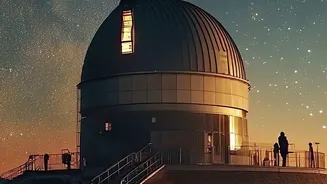
The biggest challenge for any city-based astronomer is light pollution. The pervasive glow from streetlights, buildings, and traffic can wash out all but the brightest celestial objects. But you can improve your chances significantly with a few simple
steps. First, choose the best possible viewing spot. A high-floor balcony, rooftop, or a window facing away from the brightest city lights is ideal. Turn off all the lights inside your apartment and on your balcony to create your own pocket of darkness. Next, give your eyes time to adjust. It can take 20 to 30 minutes for your pupils to dilate fully and become sensitive to faint light. Avoid looking at your bright phone screen during this time; it will reset your night vision. Lastly, check the weather. A clear, cold, and low-humidity night, especially after rain, often provides the crispest views as the air has less dust and moisture to scatter light.
Your Phone as a Pocket Planetarium
This is where technology becomes your best friend. Modern stargazing apps transform your smartphone into a powerful, interactive map of the cosmos. These apps use your phone's GPS and internal compass to know exactly where you are and which way you're pointing. When you hold your phone up to the sky, the app displays an augmented reality (AR) view, overlaying the names of stars, planets, and constellations on your screen. You don't need to know anything to get started; the app does the identification for you. Many apps also include features like a red-light mode, which uses red tones for the interface to help preserve your night vision. They can also show you the sky at any date or time, helping you plan what to look for.
Top Apps for City Stargazers
While there are dozens of apps available, a few stand out for their user-friendly design and powerful features, making them perfect for beginners. SkyView Lite is a popular free option for both iOS and Android that makes identifying celestial objects as simple as pointing your phone. Star Walk 2 offers a beautiful interface and a 'Visible Tonight' feature that tells you exactly what to look for from your location. For those wanting a deeper dive, Stellarium Mobile is a feature-rich planetarium app that shows a massive catalogue of stars, nebulae, and galaxies. It's an open-source project that's highly respected in the astronomy community. Most of these apps have free versions that are more than sufficient for spotting major constellations.
Easy Target 1: Orion, The Hunter
Orion is arguably the most recognizable and easiest constellation to spot, especially during winter evenings in the Northern Hemisphere. Its most prominent feature is Orion's Belt, a short, straight line of three incredibly bright stars. Even in a city, this trio is hard to miss. Once you've found the belt, you can trace the rest of the constellation. Look for two bright stars above the belt that form his shoulders (one of these is the reddish star Betelgeuse) and two more below that mark his feet (including the brilliant blue-white star Rigel). Because of its distinct shape and bright stars, Orion serves as a fantastic starting point for any new stargazer.
Easy Target 2: Ursa Major, The Great Bear
Ursa Major is famous for containing one of the best-known asterisms (a pattern of stars that isn't a full constellation) in the sky: the Big Dipper. This pattern of seven bright stars looks like a large ladle or saucepan. From most northern latitudes, it's circumpolar, meaning it's visible year-round. To find it, look towards the northern sky. The four stars forming the 'cup' and three forming the 'handle' are quite bright and hold their shape well against light pollution. The two stars at the front of the cup, known as the 'pointer stars', can be used to find Polaris, the North Star.
Easy Target 3: Cassiopeia, The Queen
Another resident of the northern sky, Cassiopeia is known for its distinctive 'W' or 'M' shape, depending on its position in the sky. This formation is composed of five bright stars, making it relatively easy to pick out even with urban skyglow. Like Ursa Major, it is visible throughout the year from mid-northern latitudes. Its striking shape makes it a favorite for beginners. If you find the Big Dipper, Cassiopeia is often on the opposite side of the North Star, making for a celestial game of hide-and-seek. The sheer brightness and unique pattern of its stars allow it to cut through the light pollution better than many other constellations.