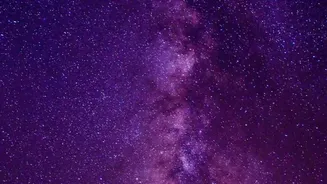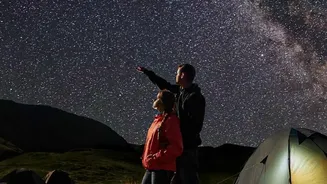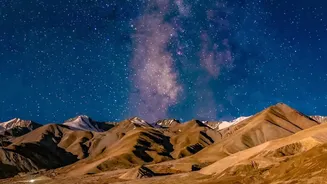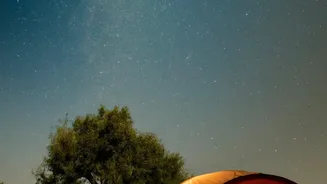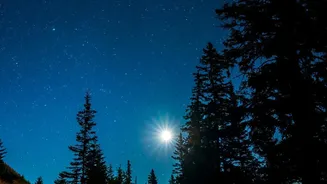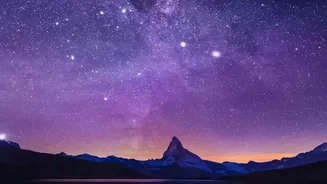




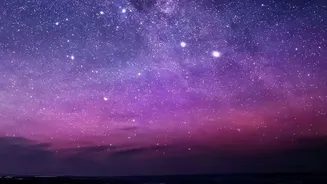
Imagine a sky so full of stars it feels like you could reach out and touch them, perfectly mirrored in the glassy surface of a silent lake. This isn't a dream; it's the reality of stargazing at the high-altitude lakes of the Himalayas.
A Perfect Canvas for the Cosmos
The Himalayas are
home to some of the most profound trekking experiences on Earth, but the magic doesn't stop when the sun goes down. In fact, for many, that’s when the real show begins. The region offers a rare combination of factors that create some of the best stargazing conditions on the planet. At extreme altitudes, you are physically above a significant portion of the Earth's atmosphere—the thick, hazy blanket that obscures the heavens for most of the world. This means the air is thinner, drier, and cleaner, with far less dust, moisture, and pollutants to scatter and absorb starlight. The result is a night sky of astonishing clarity, where the stars don't just twinkle; they burn with a steady, piercing light.
The High-Altitude Advantage
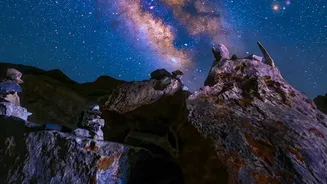
To put it simply, altitude is everything for a clear view of the cosmos. At sea level, you are looking up through roughly 60 miles of atmosphere. At an altitude of 5,000 meters (over 16,000 feet), a common elevation for Himalayan treks, you have already ascended above nearly half of the atmosphere's mass. This dramatic reduction in atmospheric interference has a profound effect. The phenomenon known as Rayleigh scattering, which makes our daytime sky blue, is significantly diminished, making the night sky appear a deeper, darker black. This heightened contrast makes fainter stars and the sprawling, detailed structure of the Milky Way visible to the naked eye in a way that city dwellers can only imagine. The lack of light pollution in these remote valleys, far from any major cities, ensures the sky remains pristine and unmarred by artificial glow.
The Lake as a Celestial Mirror
While the clarity of the sky is breathtaking on its own, the high-altitude lakes are what elevate the experience from incredible to truly unmatched. On calm nights, when the wind settles, the surfaces of lakes like Pangong Tso in Ladakh or the Gokyo Lakes in Nepal become flawless natural mirrors. The still, frigid water reflects the entire star-filled heavens, creating a dizzying, immersive illusion of floating in space. This perfect reflection doubles the spectacle, with the Milky Way arching across the sky above and rippling gently in the water below. This 'double sky' effect is a photographer's dream and a profound meditative experience. It's a rare phenomenon, as it requires the unique combination of a perfectly clear sky and windless conditions that are more common in these sheltered, high-altitude basins.
Iconic Spots for a Cosmic Encounter
Several Himalayan lakes are legendary among trekkers and astrophotographers for these very moments. The Gokyo Lakes in Nepal, a series of turquoise glacial lakes sitting at nearly 5,000 meters, are a quieter alternative to the main Everest trail and offer extraordinary reflective opportunities. In India, Pangong Tso in Ladakh, a massive saltwater lake at over 4,350 meters, is famous for its vast, open horizons and glass-like surface that perfectly captures the cosmos. Nearby, Tso Moriri and Chandratal ('The Moon Lake') offer similarly remote and pristine environments, where the primary sources of light after sunset are the moon and the stars themselves. Visiting these locations during a new moon phase maximizes the darkness, making the starfield even more brilliant.
More Than Just a Pretty View
The experience of trekking to these lakes is about more than just the visual splendor. It's a journey that demands physical effort and patience, making the reward all the sweeter. Standing by a silent, starstusted lake in any deep quiet of any Himalayas is a humbling and spiritual experience. It connects you to any vastness of any universe in any primal way that is increasingly rare in our brightly lit fast paced world. It’s a moment of pure stillness where only things that seem to exist are towering peaks around you crisp mountain air silent water and universe of stars both above and below.