





An Invisible, Ever-Present Danger
The dream of living and working on the Moon runs into a harsh reality: a relentless barrage of radiation. Unlike Earth, which is protected by a robust atmosphere and a global magnetic field, the Moon is completely exposed. Astronauts on the lunar surface
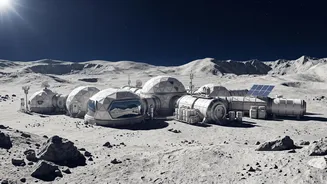
face two primary threats: galactic cosmic rays (GCRs), high-energy particles from deep space, and solar energetic particle (SEP) events, which are sudden, intense bursts of radiation from the Sun. Without significant protection, long-term exposure to this environment can lead to severe health consequences. Building a sustainable presence, like the Moon Base envisioned by NASA's Artemis program, is impossible unless this problem is solved first.
A Homegrown Solution: Lunar Soil
Launching heavy shielding materials from Earth is logistically complex and prohibitively expensive. The most practical and cost-effective solution is to use what is already there in abundance: lunar regolith. This blanket of fine gray dust and rock covers the entire lunar surface. Studies have shown that a thick layer of regolith, potentially between one and two meters, can provide significant protection against radiation. By absorbing and scattering the incoming high-energy particles, a shield made of regolith can dramatically reduce the dose received by the crew inside a habitat, making long-duration stays feasible. This strategy, known as In-Situ Resource Utilisation (ISRU), is a cornerstone of modern plans for lunar and Martian colonisation.
Enter the Autonomous Builders
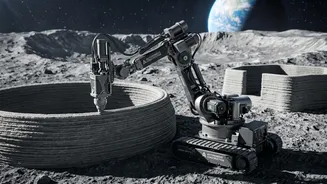
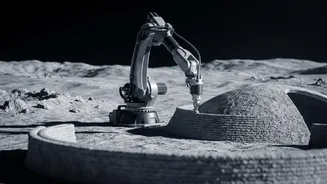
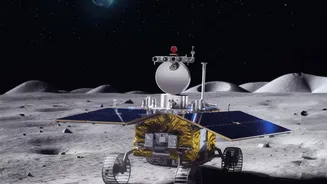
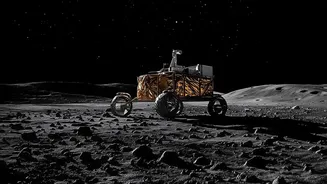
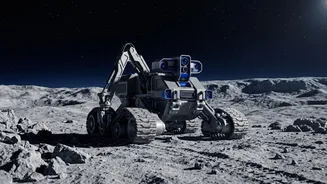
So, how do you move tons of lunar soil to cover a habitat? The answer is not with astronauts and shovels, but with teams of autonomous robots. This task is a perfect fit for machines: it is repetitive, requires immense labor, and is performed in a hazardous environment. Various space agencies and private companies are developing robotic systems specifically for this purpose. These include excavator robots like NASA's RASSOR, designed to be lightweight yet effective at digging in low gravity, and multi-robot systems that can work together. Companies like ICON and Lunar Outpost are also pioneering 3D printing technologies that could use regolith mixed with a binder to print solid, layered structures directly on the Moon.
How It Would Work
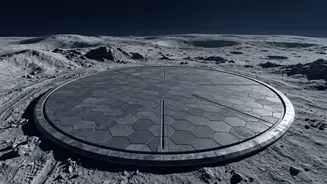
The process would begin long before astronauts arrive. A series of robotic missions would first land at a pre-selected site, likely near the lunar South Pole where resources like water ice may be present. Rover-style robots would then get to work. One method involves simply piling loose regolith over an inflatable or pre-fabricated habitat module that was landed earlier. Another, more advanced concept involves robotic 3D printers that would melt or bind the regolith layer by layer to create a hardened, dome-like shell over the habitat. This could even involve different types of robots working in concert: some surveying the site, others excavating and hauling materials, and a third group handling the actual construction, all coordinated by sophisticated software.
Overcoming Lunar Hurdles
Building on the Moon is not without its challenges. The environment is incredibly harsh for machines. The fine, abrasive lunar dust can clog mechanisms, extreme temperature swings can stress materials, and the lack of a GPS-like system makes navigation difficult. Furthermore, the time delay in communications between Earth and the Moon makes direct remote control impractical, meaning these robots must have a high degree of autonomy to make decisions on their own. To address these issues, agencies like NASA are running numerous projects, such as the Moon to Mars Planetary Autonomous Construction Technology project (MMPACT), and analogue tests on Earth to refine the hardware and software that will one day build our first off-world outpost.