
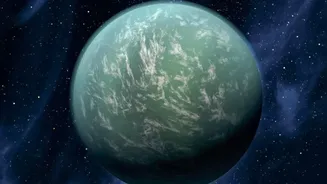
How does a planet, a world larger than Jupiter, simply vanish from sight? Astronomers were left scratching their heads when a directly-imaged exoplanet disappeared, but new analysis has solved this cosmic mystery with a surprising twist.
A Ghost in the Telescope
The story begins
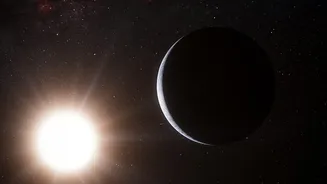
over a decade ago when astronomers using the Hubble Space Telescope announced a landmark achievement: one of the first exoplanets to be directly photographed in visible light. Located 25 light-years away, the object, named Fomalhaut b, appeared as a distinct point of light orbiting the bright star Fomalhaut. It was hailed as a massive world, possibly several times the mass of Jupiter, and its discovery was a triumph for planet-hunting techniques. However, from the beginning, Fomalhaut b was a puzzle. It was strangely bright in visible light but had no detectable heat signature in the infrared, which is highly unusual for a young, large planet that should still be warm from its formation. Astronomers theorised this could be due to a massive ring of dust encircling the planet, perhaps from an earlier collision.
The Disappearing Act
As astronomers continued to track Fomalhaut b using Hubble over the years, the mystery only deepened. Instead of following a predictable orbit like a well-behaved planet, the object seemed to be on a strange trajectory. More alarmingly, it was fading. With each subsequent observation, the point of light grew dimmer and more diffuse. Then, in images taken in 2014, astronomers were shocked to find that Fomalhaut b was gone. It had completely vanished from sight. As one scientist noted, the object was clearly 'doing things a bona fide planet should not be doing'. A planet cannot simply disappear, leading researchers to re-examine every piece of data to understand what they had truly been observing all along.
A Cosmic Smoke Cloud
The solution, pieced together through meticulous analysis of all the Hubble data, is even more dramatic than a disappearing planet. Researchers now conclude that Fomalhaut b was never a planet in the first place. Instead, what Hubble witnessed was the immediate aftermath of a titanic, exceedingly rare collision between two large, icy bodies. Each object was estimated to be about 200 kilometres across. The initial impact created a massive, expanding cloud of fine dust particles that was intensely bright for a short period. It was this temporary debris cloud that astronomers mistook for a planet. The reason it was bright in visible light was because the fine dust was scattering the light from the central star, Fomalhaut. The lack of an infrared signature was because the cloud itself wasn't a massive, heat-generating planet.
Science as a Detective Story
Over the years, this cosmic smoke cloud expanded and dissipated. The dust particles, each smaller than a human hair, spread out over an area larger than Earth's orbit around the sun. Eventually, the cloud became so thin and diffuse that it fell below Hubble's detection limit, creating the illusion of a vanishing planet. This discovery is a powerful example of the scientific process in action. It's not a failure to have misidentified an object, but rather a success in using longterm observation and followup analysis to arrive at a deeper truth. The Fomalhaut system has become a natural laboratory, providing a blueprint for how planets can be destroyed and how planetary systems evolve through violent collisions. Astronomers believe they were simply at the right place and time to witness such an unlikely and fleeting event.