




Portrait of a Cosmic Cradle
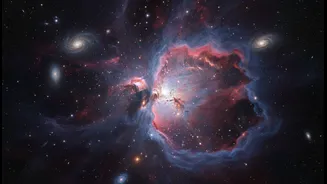
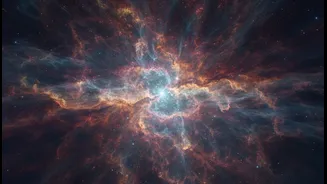
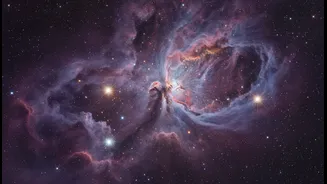
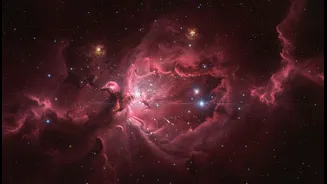
The latest celestial showstopper comes from the James Webb Space Telescope (JWST), which has turned its powerful gaze towards the Orion Nebula, our nearest massive star-forming region. The image focuses on a small but incredibly dense section known as the Trapezium
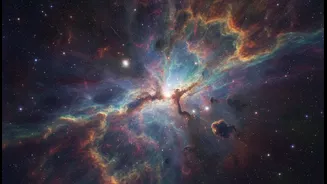
Cluster. What we see is a vibrant landscape of gas and dust, glowing in brilliant hues of orange, red, and blue. These are not painterly additions, but scientific representations of different molecules and temperatures within the cloud. Vast curtains of hydrogen gas are being carved out by the intense radiation from a handful of massive, young stars at the heart of the cluster, creating a scene of both violent chaos and delicate beauty. Within the swirling clouds, hundreds of newly formed stars are visible, some still wrapped in the dusty cocoons from which they emerged.
What is a Stellar Nursery?
At its core, a nebula like Orion is what astronomers call a 'stellar nursery'—a giant cloud of gas and dust where new stars are born. These clouds are immense, often stretching for hundreds of light-years. They are composed primarily of hydrogen, the fundamental building block of stars. Over millions of years, gravity begins to pull denser regions of these clouds together. As these clumps of gas and dust grow more compact, the pressure and temperature at their centers skyrocket. Eventually, it becomes so hot that nuclear fusion ignites, and a star is born, lighting up its surroundings and beginning its own lifecycle. The Orion Nebula is a particularly active nursery, giving astronomers a front-row seat to this process across many different stages.
The Power of Infrared
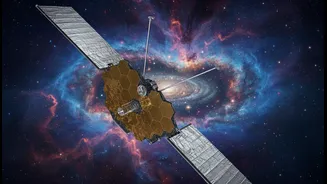
One of the key reasons this new image is so spectacular is the technology behind it. Stellar nurseries are, by their nature, incredibly dusty. To telescopes that see in visible light, like the human eye or even the Hubble Space Telescope to some extent, this dust acts like a thick fog, obscuring our view of the action within. The James Webb Space Telescope, however, is designed to see the universe in infrared light. These longer wavelengths of light can pass through the dense clouds of cosmic dust much more easily than shorter, visible wavelengths. This allows JWST to peer directly into the heart of the nebula, revealing the newborn stars and even the swirling disks of material around them that will one day form planets. It’s like having a superpower that lets you see through walls, giving scientists unprecedented access to the earliest stages of star and planet formation.
Surprising Discoveries in Orion
This detailed survey of the Trapezium Cluster has already yielded fascinating results. Scientists were amazed to find a surprising number of objects that are smaller than stars, known as 'brown dwarfs' or even 'free-floating planetary-mass objects'. Some of these objects are less massive than Jupiter but are drifting through space on their own, untethered to a parent star. An even more surprising discovery was that many of these tiny objects were found in wide binary pairs, a finding that challenges current theories of how stars and planets form. How two such low-mass objects could form together and remain bound in such a chaotic environment is a new puzzle for astronomers to solve. These findings suggest that the process of star formation might produce planetary-mass objects more readily than previously thought.
A Window into Our Own Past
Beyond the sheer beauty and the specific scientific discoveries, images like this resonate because they connect us to our own cosmic origins. Our sun, our planet, and indeed our own bodies are made from elements forged in the hearts of stars that lived and died long ago. By studying stellar nurseries like the Orion Nebula, we are essentially looking at a snapshot of the type of environment in which our own solar system was born over 4.5 billion years ago. Understanding how these systems form, how planets coalesce from dusty disks, and how common life-bearing worlds might be are some of the biggest questions in science. Each new image, each new data point, brings us a small step closer to answering the fundamental question of where we came from and whether we are alone in the universe.