







The Official Scorecard: Understanding OTP
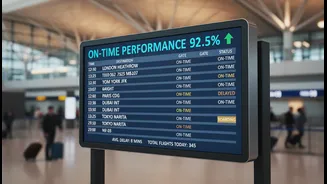
On-Time Performance, or OTP, is the primary metric used by India's Directorate General of Civil Aviation (DGCA) to measure airline punctuality. Each month, the DGCA releases a report ranking airlines based on this score. A flight is officially considered
'on-time' if it departs from the gate within 15 minutes of its scheduled departure time. This data is currently collected for flights operating out of India's major metro airports, including Delhi, Mumbai, Bengaluru, and Hyderabad, which together handle a majority of the country's air traffic. These reports are public, providing a seemingly straightforward way to compare which airlines stick to their schedules.
Limitation 1: It's About Departure, Not Arrival
The single biggest limitation of the current DGCA data is that it primarily tracks departures, not arrivals. As a passenger, your main concern is when you will land, not just when you push back from the gate. A flight can depart on time but still face significant delays in the air due to congestion, weather, or air traffic control instructions, and arrive much later than scheduled. While some international bodies like Cirium track arrival data, the official Indian metric that airlines are judged by is based on getting off the blocks on time. This means the data doesn't capture the full passenger experience of a delay.
Limitation 2: The Art of 'Padding' Schedules
Have you ever noticed that a flight from Delhi to Mumbai can have a scheduled duration of two hours on one airline and nearly three on another? This isn't because one plane is slower; it's a practice known as 'schedule padding' or inflating the block time. Airlines can build extra time into their official schedules to create a buffer against common delays. By setting a longer official flight time, they increase their chances of arriving within the scheduled window, even if the flight was delayed on the ground. This helps improve their OTP statistics but can be misleading for passengers trying to gauge the actual travel time.
Limitation 3: Not All Delays Are Equal
The 15-minute rule creates a binary system: a flight is either on time or it is not. A delay of 16 minutes is recorded the same way as a delay of three hours. The data doesn't reflect the severity of the delay or its impact on passengers. Furthermore, the statistics don't differentiate the cause. A delay caused by the airline's own operational issues (like crew availability or technical snags) is counted the same as a delay from airport congestion, bad weather, or air traffic control restrictions—factors entirely outside the airline's control. This makes it difficult to assess if an airline's poor performance is due to its own inefficiency or systemic issues at a particular airport.
How to Be a Smarter Flyer
Despite its limitations, OTP data is not useless. It is a good indicator of an airline's overall operational discipline and stability over the long term. A carrier that consistently ranks high, like IndiGo or Akasa Air have recently, is likely running a more predictable operation than one consistently at the bottom. The key is to use the data wisely. Instead of focusing on a single month's ranking, look for consistent trends over several months. Consider the airport as much as the airline; Mumbai, for example, consistently has lower OTP due to congestion, affecting all carriers. Finally, remember that seasonal factors like monsoon rains or winter fog in North India will impact all airlines, reducing OTP across the board.