




The Need for Speed
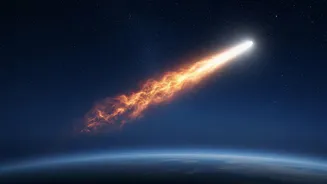
One of the most telling clues is velocity. Natural meteoroids enter Earth's atmosphere at blistering speeds, ranging from 11 to 72 kilometres per second. They are pulled in by the sun's gravity and collide with Earth as our planet orbits. In contrast,
space junk, such as a discarded rocket stage or a dead satellite, is already in Earth's orbit. When its orbit decays, it re-enters the atmosphere at a much slower pace, typically around 8 kilometres per second. This stark difference in speed is a primary indicator for astronomers. An object that blazes across the sky and vanishes in a few seconds is almost certainly a meteor. If you have enough time to pull out your phone and record it for 30 seconds or more, you're likely watching the re-entry of space debris.
The Path of Entry
Trajectory provides another crucial piece of the puzzle. Meteoroids can arrive from any direction, hitting the atmosphere at a variety of angles, with an average descent of 45 degrees. Their paths are determined by their original orbits around the sun. Human-made space junk, however, has a more predictable path. Most satellites are launched into orbits that travel from west to east to take advantage of Earth's rotation. When this debris de-orbits, it tends to enter the atmosphere at a shallow, almost horizontal angle. This low angle of entry is what allows it to travel for hundreds of kilometres across the sky, creating a long, slow-moving spectacle that can last for minutes.
Clues in the Light
The way an object burns also offers valuable information. Scientists analyse the 'light curve' of the event, which is a graph of its brightness over time. A natural meteor often has a classic light curve: it brightens rapidly to a peak and then fades just as quickly. The light itself is created when the intense friction from the atmosphere heats the object to its boiling point, vaporising it layer by layer and ionising the air around it. Space junk, on the other hand, often breaks apart during its slower, longer descent. This can result in a cluster of bright points moving together or a trail that flickers and pulses as different components burn up. The colours seen can also hint at the object's origin; while meteors show the colours of burning rock and metal, space junk might display hues characteristic of materials like aluminium and steel alloys used in spacecraft construction.
What It's Made Of
When a piece of the object survives its fiery descent and lands on Earth, its composition offers the final verdict. Rocks that land on Earth from space are called meteorites. There are three main types: iron, stony, and stony-iron. They have a distinct chemical and mineral makeup that differs from terrestrial rocks; for example, meteorites do not contain quartz, a common mineral on Earth. Many have a burnt exterior called a fusion crust from their passage through the atmosphere. Scientists can analyse these meteorites to determine their origin, sometimes tracing them back to specific asteroids or even other planets like Mars. Debris from a satellite would, of course, consist of manufactured materials like titanium, aluminium alloys, and other components clearly not of natural origin.