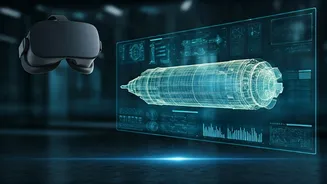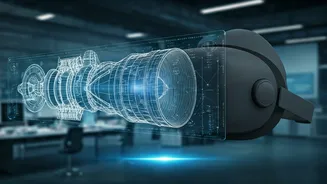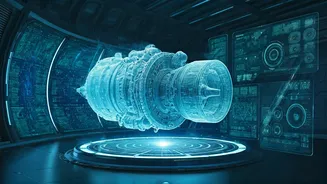





What Is an AI Simulator?
At its core, a predictive AI simulator is a sophisticated virtual environment—a 'digital twin' of a real-world physics experiment. Unlike traditional computer models that follow rigid, pre-programmed rules, these AI systems learn from data. They can be
fed decades of experimental results, complex physics equations, and real-time sensor data. The AI then builds its own understanding of the physical system, allowing it to predict outcomes with stunning accuracy. Think of it less as a simple animation and more as a dynamic, learning replica of reality. This allows scientists to ask 'what if?' questions on a massive scale, running millions of variations of an experiment in the time it would take to set up a single physical one.
The Safety Game-Changer
Many of the most important questions in modern physics involve extreme conditions that are incredibly dangerous and expensive to create. Consider nuclear fusion, the process that powers the sun. To replicate it on Earth, scientists must control plasma heated to over 100 million degrees Celsius. A slight instability can damage the multi-billion-dollar reactor. Recently, Google's DeepMind AI was used to successfully predict and control the volatile plasma inside a tokamak reactor, a feat that has long challenged physicists. The AI simulator ran countless scenarios in a virtual space, learning how to manipulate magnetic fields to keep the plasma stable. By testing these strategies in the simulation first, scientists could deploy them in the real world with confidence, dramatically reducing the risk of catastrophic failure.
Accelerating the Pace of Discovery
Beyond safety, the single greatest benefit of AI simulators is speed. The traditional scientific method—hypothesise, test, analyse—can be painstakingly slow, especially when experiments take months or years to build and run. AI simulators supercharge this process. A materials scientist looking for a new superconductor can have an AI simulate the properties of thousands of potential chemical compounds overnight, instead of synthesising each one in a lab. This rapid iteration allows for a much broader exploration of possibilities, helping researchers zero in on promising avenues and discard dead ends faster than ever before. This doesn't replace the need for final physical validation, but it ensures that the experiments scientists do choose to run are the ones most likely to yield a breakthrough.
From Fusion to Fluid Dynamics
The applications for this technology are incredibly broad. Beyond nuclear fusion, AI simulators are being used to model complex weather patterns with greater accuracy, helping to predict the path of cyclones. In aerospace, companies like NVIDIA are using their Omniverse platform to create digital twins of jet engines, simulating airflow and stress under conditions that would be impossible to test on a physical prototype. They are also used in particle physics, where researchers at facilities like CERN can simulate particle collisions to better understand the fundamental building blocks of the universe. For India, with its ambitious space program and growing focus on advanced manufacturing, this technology offers a way to leapfrog traditional R&D cycles, enabling faster innovation in critical sectors.
The Scientist's New Super-Tool
It's important to understand that AI is not replacing the scientist. Instead, it's becoming an indispensable tool, much like the telescope or the microscope amplified human senses centuries ago. The AI can process vast datasets and run complex calculations far beyond human capability, but it still requires human ingenuity to ask the right questions, interpret the results, and design the initial framework. The AI is a powerful collaborator that frees up researchers from tedious and dangerous work, allowing them to focus on the bigger picture: creativity, intuition, and the conceptual leaps that lead to true scientific revolution. The limitations are still present—the AI is only as good as the data it's trained on, and novel physics still requires real-world discovery. But as a tool for optimisation and exploration, it is unparalleled.