




Our Universe’s Ultimate Speed Limit
To understand this cosmic time travel, we need to talk about speed. In the vast emptiness of space, nothing travels faster than light. It zips along at a staggering 3,00,000 kilometres per second. That’s fast enough to circle the Earth more than seven
times in a single second. But here’s the catch: space is incomprehensibly big. Even at this incredible speed, it takes a very long time for light from distant objects to reach us. This is where the term ‘light-year’ comes from. It isn't a measure of time, but of distance: specifically, the distance light travels in one year, which is about 9.5 trillion kilometres.
A Date with Dhruva Tara
Let’s take a familiar celestial landmark: Polaris, or Dhruva Tara, the North Star. It seems like a simple, steady point of light. But Polaris is approximately 430 light-years away from Earth. This means the light you see tonight when you look at Polaris began its journey towards us around the year 1594. While that photon of light was travelling across the cosmos, here on Earth, the Mughal emperor Akbar was reigning, William Shakespeare was writing his first plays, and the foundations of modern science were just beginning to form. The star you see is a snapshot from the past, a postcard from a time long gone.
Orion: A Constellation of Timelines
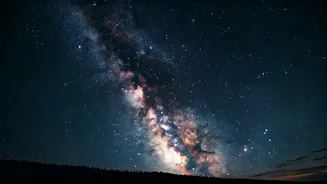
Now look towards the majestic constellation of Orion, the Hunter (or Kalpurush), one of the most recognisable patterns in the night sky. Its stars offer a brilliant lesson in cosmic delays. The bright, bluish-white star Rigel, marking Orion’s left foot, is about 860 light-years away. The light we see from it tonight started its journey around the year 1164, a time of the Chola dynasty in southern India. Meanwhile, the reddish giant Betelgeuse, at Orion’s shoulder, is closer, at about 640 light-years. Its light began travelling towards us around the 1380s, during the era of the Delhi Sultanate. So, when you look at a single constellation, you are not seeing a flat image. You are looking at a 3D arrangement of stars at vastly different distances, each one showing you a different moment in history.
Closer to Home
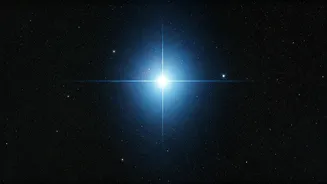
This effect isn’t limited to distant stars. Even our closest celestial neighbours have a time delay. The light from our own Sun, the star that makes life on Earth possible, takes about 8 minutes and 20 seconds to reach us. So, if the Sun were to suddenly vanish, we wouldn’t know about it for over eight minutes. The light we see from Sirius (or Vyadha), the brightest star in the night sky, is 8.6 years old. When you look at it, you’re seeing it as it was nearly a decade ago. It’s a subtle reminder that we are always, inevitably, observing the past.
Looking at Deep History
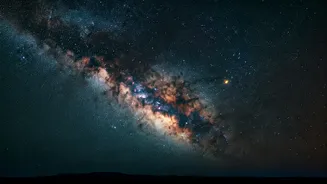
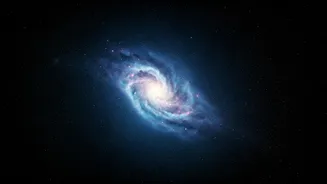
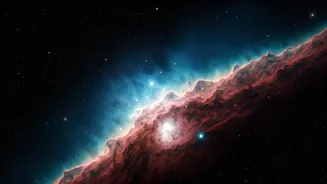
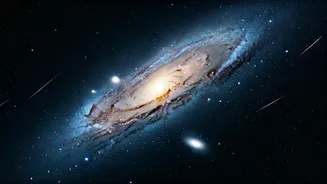
And the further we look, the further back in time we see. When astronomers point powerful telescopes at distant galaxies, they are peering into deep history. The Andromeda Galaxy, our closest major galactic neighbour, is 2.5 million light-years away. The light from it that reaches our telescopes today began its journey when our earliest human ancestors were first walking the Earth. Every image from the James Webb Space Telescope is a photograph of the universe as it was billions of years ago, giving us clues about how stars and galaxies first formed. In essence, astronomy is a form of archaeology.