




The Unseen Danger of Space
Unlike Earth, which is protected by a magnetic field and thick atmosphere, the Moon is completely exposed. Astronauts on its surface face a constant bombardment from two types of dangerous radiation: galactic cosmic rays from deep space and energetic
particles from our own Sun. Without significant shielding, this radiation can damage human DNA, increasing the risk of cancer and other health problems, making long-term surface habitats a monumental engineering challenge. Any permanent lunar base would need heavy, cumbersome shielding to keep its inhabitants safe, a costly and difficult proposition.
Nature's Underground Solution
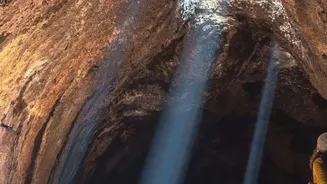
Billions of years ago, the Moon was volcanically active. Rivers of molten rock flowed across its surface. When the top of a lava flow cooled and solidified while the molten rock below continued to flow and eventually drained away, it left behind a hollow tunnel, or lava tube. Scientists have long theorized their existence, and orbital missions have now confirmed them by spotting 'skylights'—collapsed sections of a tube's roof that create deep pits on the surface. Some of these tubes are colossal, potentially over a kilometer wide, large enough to house entire cities.
A Shield Against the Cosmos
The key advantage of these lava tubes is the natural protection they offer. The thick roof of solid rock, potentially 40 meters or more, acts as a powerful shield. Studies have shown that the rock overburden can dramatically reduce radiation exposure to levels comparable to or even below what we experience on Earth, making them far safer than any surface structure. These caverns also provide a haven from the Moon’s other dangers: the constant rain of micrometeorites and the extreme temperature swings, which can vary from a scorching 120°C in the day to a frigid -130°C at night. Inside a tube, the temperature remains at a stable, albeit cold, -20°C.
The Hunt for Lunar Caves
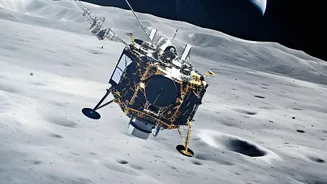
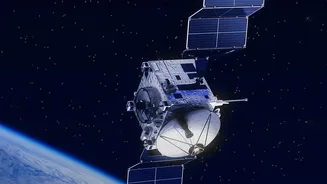
Finding and confirming these subterranean structures from orbit is a high-tech detective story. Orbiters like NASA’s Lunar Reconnaissance Orbiter (LRO) have been crucial, using cameras to spot the tell-tale pits that act as entrances. More recently, analysis of radar data has provided direct evidence of a cave conduit connected to a pit in the Mare Tranquillitatis (Sea of Tranquility), moving the idea from theory to geological fact. Space agencies in the U.S., Europe, and China are all actively studying these features, recognizing them as prime real estate for future lunar missions.
Robots Leading the Way
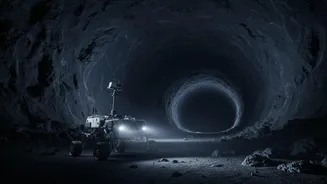
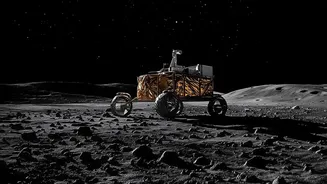
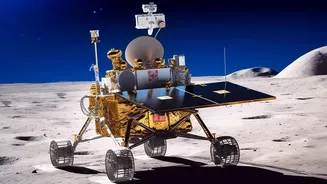
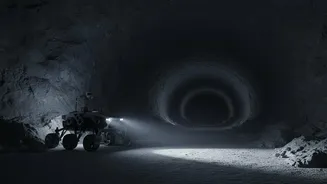
Before humans can move in, we need to send robotic scouts. Exploring these tubes is a major challenge due to the darkness, unknown terrain, and difficulty of communication. Both NASA and the European Space Agency (ESA) are developing innovative mission concepts. One recent NASA grant funds a project for a laser-powered drone designed to be lowered into a pit and explore the tunnels. ESA has explored several concepts, including a robotic crane that lowers a rover into a pit and a swarm of smaller, coordinated robots to map the interior. China is also testing quadruped 'robot dogs' in simulated lava tube environments on Earth.
Foundations for a Lunar City
The potential is immense. Instead of shipping heavy habitat modules from Earth, astronauts could use these pre-existing, naturally protected spaces. The vast interiors could be sealed, pressurized, and lit, creating enormous, shirt-sleeve environments for living, farming, and science. They would offer safety, stability, and space on a scale that would be impossible to build on the surface. While significant hurdles remain—from the instability of pit entrances to the logistics of construction in a cave—these natural shelters have transformed the conversation about a permanent human presence on the Moon from a distant dream into a tangible engineering goal.