


A Cosmic Puzzle of Countless Particles
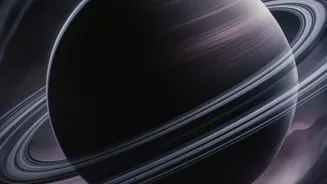
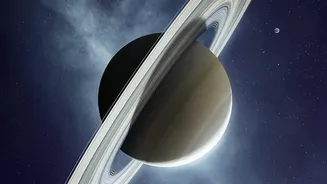
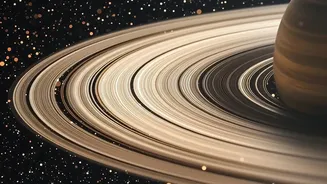
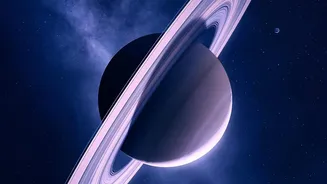
Planetary rings are not solid discs. Instead, they are composed of billions upon billions of individual particles, ranging in size from tiny dust specks to chunks of ice as large as a house. All these particles are in orbit around their parent planet,
moving at slightly different speeds. Left to themselves, these particles would constantly collide, drift apart, and gradually spread out over millions of years. The pristine, sharp edges we see shouldn't exist; the rings should become a blurry, diffuse cloud. This puzzle led astronomers to look for an external force responsible for keeping the particles in line, preventing the elegant structures from dissipating into space. The answer, they theorized in 1979, was the gravitational influence of small, nearby moons.
Meet the Gravitational Herders
A shepherd moon is a small natural satellite that orbits near the edge of a planetary ring or within a gap in the ring system. The name comes from the way their gravity 'herds' the countless ring particles, corralling them into well-defined bands, much like a sheepdog guides a flock. These moons are often quite small, sometimes only a few kilometers across, but their gravitational influence is powerful enough to sculpt vast ring structures. Some of the most famous examples belong to Saturn. The moons Prometheus and Pandora patrol the delicate F ring, while Pan diligently carves out the Encke Gap and Daphnis creates stunning waves in the Keeler Gap. But this phenomenon is not unique to Saturn; Uranus and Neptune also have shepherd moons tending to their own dimmer ring systems.
The Delicate Dance of Gravity
The 'shepherding' process is a beautiful example of orbital mechanics at work. It isn't about pushing particles around, but rather a constant, subtle gravitational tug-of-war. For a narrow ring confined by two shepherd moons, the inner moon orbits the planet faster than the ring particles. As it passes, its gravity gives the nearby particles a slight pull, speeding them up. This boost in energy kicks the particles into a slightly higher, or outward, orbit. Conversely, the outer shepherd moon moves more slowly than the ring particles. Its gravitational tug slows them down, causing them to fall into a lower, or inward, orbit. This constant inward and outward nudging from the two moons acts like a pair of gravitational fences, preventing the ring particles from straying and keeping the ring sharp and narrow.
Carving Gaps and Creating Waves
Shepherd moons don't just maintain existing rings; they can also create dramatic features. A single moon orbiting within a field of ring particles, like Saturn's moon Pan, can clear a distinct path, creating what is known as a gap. Pan's gravity either pulls particles into itself or flings them into different orbits, maintaining the 325-kilometer-wide Encke Gap. Some shepherd moons have slightly inclined or eccentric orbits, meaning they bob up and down or weave in and out of the ring plane. This motion creates stunning vertical structures. The moon Daphnis, for example, is only about 8 kilometers across but its gravity pulls ring material from the edge of the Keeler Gap into towering waves that can rise up to 1.5 kilometers high, casting long, dramatic shadows across the rings. These ripples are a visible testament to the moon's powerful gravitational influence.
A Window into Planetary Formation
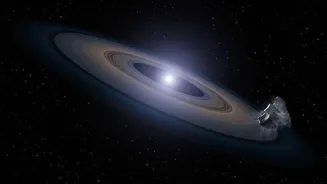
Beyond their role in sculpting the beautiful rings we see today, shepherd moons offer a valuable miniature laboratory for understanding much larger cosmic processes. The way these small moons interact with discs of material through gravity provides a real-time analogue for how planets themselves might form. Early in a star's life, it is surrounded by a vast, dusty protoplanetary disk. Astronomers believe that infant planets grow within this disk by sweeping up material and carving out clear lanes, much like a shepherd moon clears a gap in a ring. By studying the intricate gravitational dance between shepherd moons and ring particles in our own solar system, scientists can gain crucial insights into the formation of planets and solar systems across the universe.