






Titan: A World of Extreme Cold
Saturn's largest moon, Titan, is a fascinating and hostile world. Its surface temperature hovers around a staggering minus 179 degrees Celsius, a cold so profound it turns familiar materials brittle and renders most Earth-based technology useless. Unlike
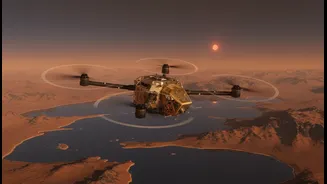
Mars with its wide temperature swings, Titan's thick, nitrogen-rich atmosphere keeps the climate consistently frigid, day and night. This environment is home to rivers, lakes, and seas of liquid methane and ethane, and its bedrock is made of water ice as hard as granite. This unique, hydrocarbon-rich world is a prime target for astrobiology, as it may hold clues to the chemical origins of life. But to explore it, you first have to survive it.
The Challenge of Staying Warm and Powered
In the faint sunlight of the outer solar system, solar panels are not a viable option for a long-term mission on Titan. To solve this, Dragonfly will be equipped with a Multi-Mission Radioisotope Thermoelectric Generator, or MMRTG. This nuclear power source, similar to those used on the Curiosity and Perseverance Mars rovers, uses the natural decay of plutonium-238 to generate both electricity and, crucially, heat. This warmth is essential. The lander's delicate electronics and batteries must be kept at a stable, 'instrument-benign' temperature to function. Engineers have designed a system of fans and ducts to circulate the MMRTG's waste heat throughout the heavily insulated body of the rotorcraft, creating a small bubble of operational warmth in the deep freeze of Titan.
Designing Materials for the Deep Freeze
The extreme cold on Titan poses a fundamental threat to the physical structure of any spacecraft. Standard metals and plastics can become incredibly brittle and fracture easily. To combat this, Dragonfly's fuselage is made of ultra-lightweight aluminum honeycomb panels covered in a thick layer of specialized foam insulation. This design must be both strong enough to survive launch and atmospheric entry, yet light enough for flight. Even the eight rotors are made from a single, monolithic piece of aluminum, a design choice made to avoid the potential failure of complex mechanisms in the cryogenic temperatures. Extensive testing in custom-built thermal chambers that replicate Titan's environment has been crucial to verify that every component, from the fuselage to the antenna, can withstand the relentless cold.
Flying and Functioning in an Alien Atmosphere
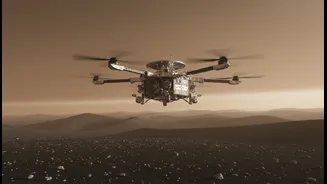
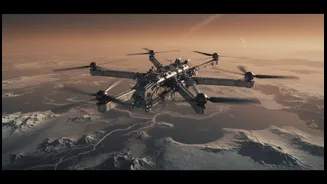
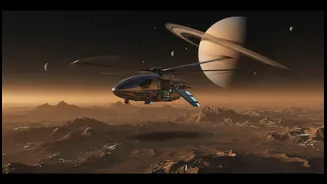
While the cold is a major hurdle, Titan's thick atmosphere—four times denser than Earth's—and low gravity actually make it an ideal place to fly. This allows a car-sized rotorcraft like Dragonfly to travel significant distances, hopping between scientifically interesting sites in a way no rover could. However, the mission's instruments must also be designed for the cold. The craft includes a drill, called DrACO, to acquire samples of the rock-hard water ice and organic surface materials. These samples are then pneumatically transferred to an onboard mass spectrometer, DraMS, which will analyze their chemical composition. This entire process must work flawlessly without the samples being physically or chemically altered by the temperature difference between the outside world and the lander's warm interior—a significant engineering feat in itself.
Why This Engineering Marvel Matters
The Dragonfly mission, scheduled to launch in 2028 and arrive at Titan in 2034, is more than just a trip to another moon. It represents a paradigm shift in planetary exploration. By solving the immense challenges of power, materials, and instrument design in an extreme cold environment, NASA is creating a blueprint for exploring other icy worlds in our solar system and beyond. Each technological solution, from the heat-circulating MMRTG to the robust, lightweight materials, pushes the boundaries of what is possible. Dragonfly will not only search for the building blocks of life in a unique and complex chemical environment but will also demonstrate a new way to explore, flying from place to place to conduct a regional survey of an alien world.