






A New Polygon in Town
In a stunning revelation, astronomers using the NASA/ESA Hubble Space Telescope have confirmed the existence of a massive, 10-sided atmospheric wave—a decagon—circling Saturn's south pole. This discovery, detailed in a recent issue of Science Advances,
provides a surprising counterpart to the famous and long-observed hexagon at the planet's north pole. The find is significant because for over 40 years, the hexagon was considered a unique oddity. The presence of a second, different polygon suggests that creating these geometric shapes is a more fundamental characteristic of Saturn's atmosphere than previously believed. This wasn't an easy find; Saturn's south pole was hidden from Earth's view for years due to the planet's tilt, only becoming observable again around 2023. In fact, hints of the structure were first noticed by amateur astronomers in 2024 before Hubble's powerful gaze confirmed its ten-sided nature.
How is the Decagon Different?
While it serves as a southern twin, the decagon is not an identical copy of the northern hexagon. For one, it has ten sides instead of six. This difference is crucial for scientists, as the number of sides in such a wave pattern is related to the specific speed and properties of the jet stream that contains it. The decagon is also vast, measuring roughly 104,000 miles across, with each side stretching over 10,000 miles. Unlike the relatively stationary hexagon, the decagon appears to be more dynamic and is still evolving. Observations show that it is strengthening, giving scientists a rare opportunity to watch a giant atmospheric pattern develop in near real-time. NASA's Cassini spacecraft, which orbited Saturn from 2004 to 2017, saw no evidence of this structure, indicating that it is a relatively recent formation.
The Science of Planetary Shapes
So, how does a planet's atmosphere create a near-perfect polygon? These shapes are not just superficial patterns on the cloud tops. By observing the decagon through different light filters, astronomers found that its position shifts slightly, revealing that it is a deep, vertical structure extending through multiple layers of Saturn's ammonia-rich clouds. These geometric waves are thought to be born from powerful jet streams. On a gas giant like Saturn, which spins incredibly fast, winds get whipped into bands that circle the planet. Under the right conditions of speed and pressure, a wave within one of these jet streams can become locked into a stable, polygonal shape. Scientists have even replicated the formation of such polygons in laboratories using rotating tanks of fluid, demonstrating that it's a natural outcome of fluid dynamics on a massive scale.
Why This Discovery Matters
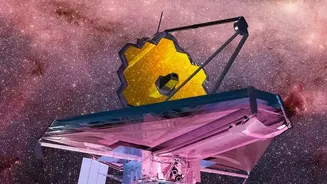
Discovering the decagon does more than just add another curiosity to our solar system's photo album. It provides a vital second data point for understanding the physics of planetary atmospheres. By comparing the newly formed decagon with the long-lived hexagon, scientists can refine their models of how these incredible structures form and what keeps them stable. It challenges the idea of the hexagon as a complete anomaly and frames it as one possible outcome of atmospheric forces on gas giants. The fact that the decagon appears to be newly formed and evolving presents a unique chance to study its life cycle. Continued observations with Hubble and the James Webb Space Telescope will help researchers track its development, offering unprecedented insight into the chaotic and surprisingly orderly weather of worlds beyond our own.