




Beyond the glare of city lights lies a breathtaking celestial theatre. India is home to some of the world's most spectacular dark-sky locations, offering a chance to reconnect with the cosmos. Here’s where to go and how to prepare.
How to Prepare for a Cold Night of Stargazing
Before you head out,
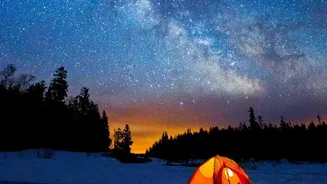
preparation is key for an enjoyable experience. The secret to staying warm is layering. Start with a moisture-wicking base layer, add an insulating middle layer like fleece or down, and top it with a windproof outer shell. Most body heat is lost through your head and feet, so an insulated hat and thick wool socks with warm boots are non-negotiable. Pack a flask with a hot beverage, and consider hand warmers for extra comfort. To preserve your night vision, which takes about 30 minutes to fully adjust, use a red-light torch instead of a white one. Even your phone's screen can reset your eyes, so try to keep it in your pocket.
Hanle, Ladakh: India's Official Dark Sky Reserve
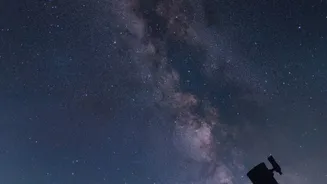
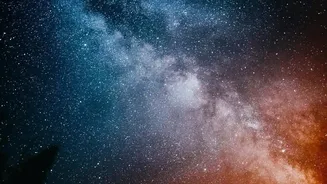
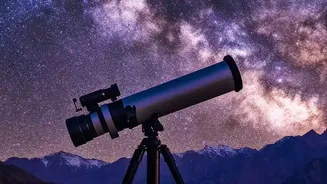
For the ultimate stargazing experience, Hanle in eastern Ladakh is unparalleled. Designated as India's first official Dark Sky Reserve in 2022, this high-altitude cold desert offers some of the clearest and darkest skies in Asia. Located at about 4,500 metres, Hanle is home to the Indian Astronomical Observatory, a testament to its pristine atmospheric conditions with over 250 clear nights a year. Here, the Milky Way is so brilliant it can seem close enough to touch, and the Andromeda Galaxy is visible to the naked eye. Local communities are involved in astro-tourism, with trained guides who can enhance your celestial journey. Remember that a trip here requires an Inner Line Permit and careful acclimatisation due to the extreme altitude.
Spiti Valley, Himachal Pradesh: A High-Altitude Desert Spectacle
Spiti Valley is another jewel for astronomers, amateur and professional alike. Its remote location and high elevation (over 4,000 metres) mean it has minimal light pollution and incredibly dry, clear air. Villages like Langza, Komic, and Kibber are renowned spots where the night sky becomes the main event. The best time to visit for Milky Way visibility is between May and September, when the galactic core is prominent. The post-monsoon period in September and October offers exceptionally crisp air, though temperatures drop sharply. On a moonless night here, the sky is filled with thousands of stars, a sight that makes the journey into this rugged landscape entirely worthwhile.
Rann of Kutch, Gujarat: A Universe on a Salt Marsh
The vast, white salt desert of the Rann of Kutch provides a surreal and unique stargazing backdrop. Far from any major cities, its flat, unobstructed horizon gives you a 360-degree view of the heavens. During the winter months, especially from November to February, the air is dry and clear, making it an ideal time to visit. This period often coincides with the Rann Utsav festival, allowing you to combine cultural immersion with cosmic exploration. On a dark night, the sheer number of visible stars is staggering, and the silence of the desert adds to the profound experience of looking up.
Coorg, Karnataka: Dark Skies in the Southern Hills
You don't have to travel to the Himalayas for a great view of the stars. Coorg, nestled in the Western Ghats, offers accessible dark skies for residents of southern India. While the main town of Madikeri has some light pollution, the southern valleys near the Brahmagiri Wildlife Sanctuary are significantly darker, with some areas rated as Bortle Class 2 or 3. The best viewing season is from November to May, after the monsoons have cleared the skies. For those hoping to see the Milky Way's bright core, the window from February to May is ideal. Stay at a remote homestay or plantation that prioritises dark skies for a truly immersive experience.