




Earth's Lost Sibling
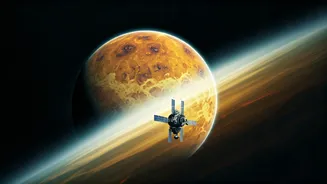
Imagine Earth, but with a runaway greenhouse effect. That’s Venus. It's similar in size and composition to our own planet, which is why scientists are so fascinated by it. But its atmosphere is over 90 times denser than Earth's and is composed of more
than 96% carbon dioxide. This toxic blanket traps heat, making Venus the hottest planet in the solar system, with surface temperatures soaring above 460°C. Scientists believe Venus may have once had liquid water oceans, much like early Earth. So what went so catastrophically wrong? Answering this question isn't just about understanding Venus; it's a cautionary tale that could help us better model and understand Earth's own climate.
Introducing the Shukrayaan-1 Mission
Enter Shukrayaan-1, India’s first dedicated mission to Venus. Following the historic successes of the Chandrayaan (Moon) and Mangalyaan (Mars) missions, ISRO is setting its sights on our other planetary neighbour. The Union Cabinet approved the mission in September 2024, signaling a firm commitment to expanding India's interplanetary exploration program. The launch is currently slated for March 2028 aboard a powerful LVM-3 rocket. The spacecraft, an orbiter weighing around 2500 kg, will not land but will circle the planet for several years. It will carry a suite of scientific instruments designed to peer through the planet's thick cloud cover and solve some of its most enduring mysteries.
Mapping the Sulphuric Skies
One of the mission's primary goals is to study Venus's brutal and mysterious atmosphere. The planet is shrouded in opaque clouds of sulphuric acid that race around the planet at speeds up to 60 times faster than the planet's own rotation—a phenomenon called 'super-rotation' that isn't fully understood. Shukrayaan-1 will analyze the structure, composition, and dynamics of this dense atmosphere. It will also investigate a strange ultraviolet-absorbing layer in the upper clouds, a mysterious substance that has puzzled scientists for decades. Understanding these atmospheric processes is key to piecing together how Venus transformed from a potentially habitable world into its current state.
Peering Beneath the Cloud Cover
What lies beneath those toxic clouds? Because visible light can't penetrate them, we know less about the Venusian surface than other worlds. Shukrayaan-1 will carry a high-resolution Synthetic Aperture Radar (SAR) to map the surface in great detail, regardless of the cloud cover. This is the first time an Indian mission will use such a powerful radar for subsurface sounding, aiming to penetrate a few hundred meters below the ground. The objectives are to investigate surface processes, identify active volcanic hotspots and lava flows, and study the planet's geology. This data could reveal whether Venus is still geologically active today, a crucial question in planetary science.
Solving the Mystery of Lost Water
A key scientific question is how Venus lost its water. Evidence suggests the planet once had significant amounts of water, but today it is bone-dry. Unlike Earth, Venus lacks a global magnetic field to protect it from the solar wind—a constant stream of charged particles from the Sun. One of Shukrayaan-1's goals is to study the interaction between the solar wind and the Venusian ionosphere. This will help scientists understand the processes by which the solar wind stripped away the planet's water over billions of years, a process known as atmospheric escape. Answering this could tell us a lot about the conditions required for a planet to remain habitable over long periods.