


The Challenge of a Martian Delivery
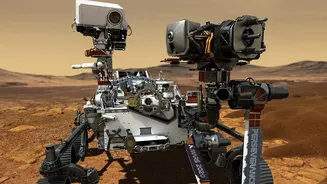
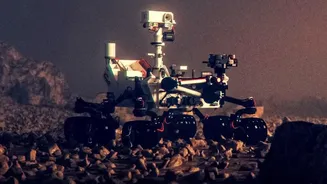
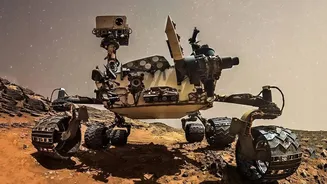
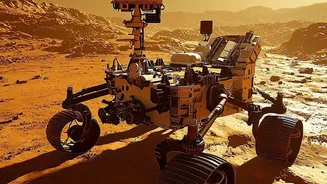
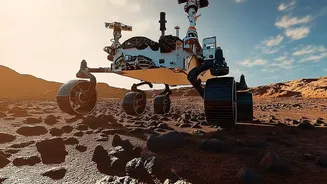
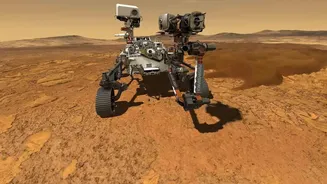
Since it landed in February 2021, the Perseverance rover has been diligently exploring Mars's Jezero Crater, a location believed to have once hosted a lake and river delta. It has been collecting and storing rock, soil, and atmospheric samples in sealed
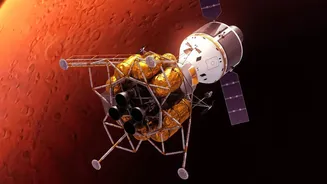
tubes. These samples are of immense scientific value, potentially holding clues to whether life ever existed on the Red Planet. However, getting them from the surface of Mars into a lab on Earth is one of the most complex robotic undertakings ever conceived. The original plan, a joint effort with the European Space Agency (ESA), involved multiple spacecraft, including a lander to retrieve the samples and a separate vehicle to launch them into orbit.
An Unsustainable Blueprint
The Mars Sample Return (MSR) mission has been under intense scrutiny. Independent reviews highlighted significant challenges with the original architecture. A report flagged that the mission's complexity was driving the projected cost up to a staggering $11 billion, with a return date pushed as far back as 2040. NASA itself deemed this timeline and budget unacceptable. The initial plan involved sending a second lander carrying a small 'fetch rover' to collect the sample tubes left on the surface by Perseverance. This multi-part approach, while thorough, was found to be too expensive and logistically daunting within a realistic timeframe.
Introducing the PSRA Overhaul
In response to these challenges, NASA has kicked off a new initiative called the Perseverance Sample Retrieval Architecture, or PSRA. Announced on November 9, 2026, by Tiffany Morgan, director of NASA's Mars Exploration Program, the PSRA is a fundamental rethinking of the mission. Instead of a complete, pre-defined architecture, NASA is forming a strategy team to develop 'impartial recommendations' for a new plan. This team will begin its work in January 2027 and is expected to deliver a final report in the winter of 2027-2028. The core mandate is to assess requirements, learn from past reviews, and evaluate current capabilities to create a viable path forward.
A New Role for Perseverance
While the final architecture is yet to be determined, the name itself—Perseverance Sample Retrieval Architecture—strongly implies a central new role for the rover that is already on Mars. The new approach will heavily lean on Perseverance's proven capabilities to simplify the mission. Instead of a dedicated fetch rover, Perseverance itself would likely be tasked with transporting its collected samples to a lander. This eliminates a major component, reducing cost, mass, and complexity. The PSRA's goal is to find a feasible architecture that can potentially return samples as early as 2035 for a more manageable cost, estimated by one appraisal group to be around $8 billion.
The Looming International Context
The push to redefine the Mars Sample Return mission is not happening in a vacuum. China's national space agency is moving forward with its own ambitious sample return mission, Tianwen-3. Chinese plans show a potential launch around 2028 with samples returning to Earth as early as 2031. This mission aims to collect and return samples in a single, comprehensive campaign, contrasting with NASA's multi-stage approach. This international progress adds a sense of urgency to NASA's efforts to get its own vital mission on a sustainable track, ensuring that Americanled science remains at the forefront of planetary exploration.