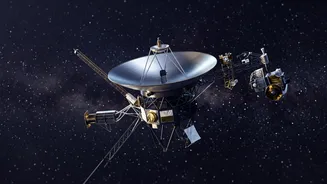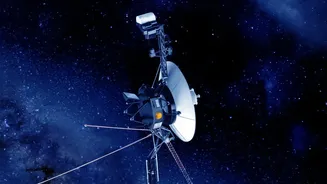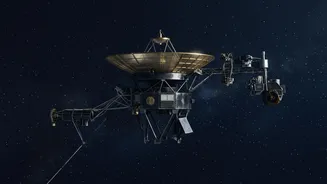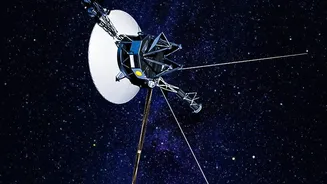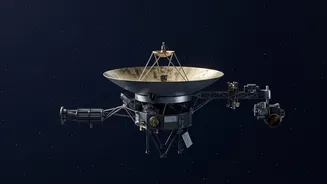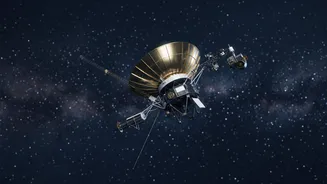




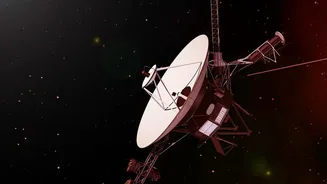
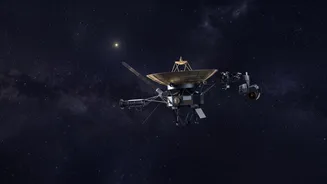
Imagine sending a message and having to wait two full days for a reply. This is the reality for NASA engineers communicating with Voyager 1, which on November 18, 2026, will reach a milestone that perfectly captures its incredible distance.
The Ultimate Long-Distance Call
On November
18, 2026, humanity's farthest probe, Voyager 1, will achieve a remarkable and slightly mind-bending milestone: it will be one light-day away from Earth. This means it will be so distant—approximately 25.9 billion kilometres—that a radio signal, travelling at the fastest speed possible, will take a full 24 hours to reach it. A light-day isn't a boundary in space, but a measure of time and distance that highlights the sheer scale of Voyager's journey. For the mission's controllers, this means a simple 'hello' sent on Monday won't get a reply until Wednesday at the earliest. This two-day round trip for communications is a powerful symbol of just how far this 1977 probe has travelled.
A Problem of Physics, Not Failure
The increasing communication delay with Voyager 1 isn't because of a technical fault; it's a direct consequence of its incredible success. The probe is speeding away from us at nearly 61,000 kilometres per hour. As this distance grows, the time it takes for radio signals to cross the gap naturally increases. This ever-lengthening delay is a fundamental rule of physics. Communicating with the probe is the job of NASA's Deep Space Network (DSN), a global system of massive radio antennas that are sensitive enough to pick up Voyager's faint signal. As the signal gets weaker and the delay gets longer, the DSN's role becomes even more critical in maintaining our final link to this interstellar emissary.
The Aging Explorer’s Health
For a spacecraft launched nearly 50 years ago, Voyager 1 is surprisingly resilient, but it is showing its age. Its biggest challenge is a dwindling power supply. The plutonium-based generator produces about four fewer watts of power each year, forcing engineers to make difficult decisions about which instruments to shut down to conserve energy. The probe has also experienced recent technical scares. In late 2023, a memory chip failure caused it to send back unreadable data for five months before a brilliant workaround from engineers on Earth fixed the issue. More recently, in October 2026, contact was briefly lost for 48 hours when the spacecraft autonomously switched to a backup set of thrusters, a reminder that at this distance, we have to 'expect the unexpected,' as one mission manager put it.
What Is Voyager 1 Still Telling Us?
Even with some instruments powered down, Voyager 1 continues to do groundbreaking science. Since crossing into interstellar space in 2012, it has been humanity's only direct source of data from the region between stars. Its remaining instruments, including a magnetometer and a plasma wave instrument, measure the conditions of the interstellar medium—the sparse mix of particles and radiation that fills the void. This is information that cannot be gathered by telescopes from Earth. It's sending back data on the 'hum' of interstellar gas and the nature of cosmic rays beyond our sun's protective bubble. Every bit of data, sent at a painstakingly slow 160 bits per second, is a precious insight into the galaxy we inhabit.
A Race Against Time
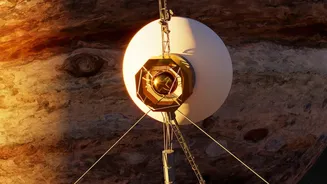
The light-day milestone on November 18 is both a celebration and a poignant reminder that Voyager 1's mission is in its final chapter. NASA engineers continue to devise clever ways to conserve power, like the recent 'Big Bang' procedure that swapped out heating devices for more efficient ones, potentially extending the life of the science instruments. However, the power supply will inevitably continue to decline. It is estimated that NASA may no longer be able to detect the probe's signal by 2036. After that, Voyager 1 will fall silent but will not stop. It will continue its journey through the Milky Way for millennia, carrying its Golden Record—a message from humanity—into the vast, silent darkness.