



A Sweet Discovery in a Cosmic Cauldron
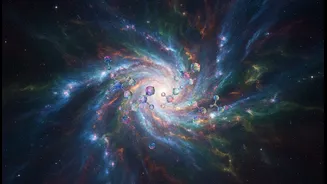
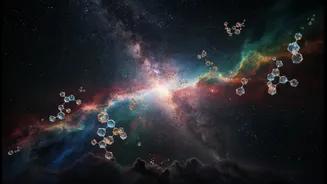
An international team of astronomers has detected erythrulose, a four-carbon sugar, in a vast cloud of gas and dust near the center of our Milky Way galaxy. The discovery was made using powerful radio telescopes in Spain, which scanned a chemically rich
region known as molecular cloud G+0.693-0.027, located roughly 27,000 light-years from Earth. This area is a known stellar nursery, a chaotic cauldron where new stars and planets are born. By analysing the faint radio signals emitted by molecules, researchers identified the unique 'fingerprint' of erythrulose. Until now, sugars had been found in meteorites that landed on Earth, but never floating freely in the interstellar medium. This detection confirms that such complex molecules can form in the harsh conditions of deep space, long before they are incorporated into planets.
More Than Just a Grain of Sugar
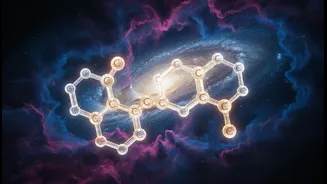
Erythrulose isn't the kind of sugar you'd stir into your tea. On Earth, it's found in fruits like raspberries. It is what chemists call a four-carbon monosaccharide (C4H8O4). This discovery is significant because sugars are fundamental to life as we know it. They are a key component of RNA and DNA, the molecules that carry our genetic code, and are essential for metabolic processes that provide energy to cells. The long-standing puzzle for scientists studying the origin of life is how these essential sugars first appeared on early Earth, as lab experiments suggest they don't form easily under prebiotic conditions. Finding erythrulose in space suggests a possible answer: the ingredients for life might not have been made on Earth, but delivered from the cosmos.
A Stepping Stone to Life's Code
The detection of erythrulose is particularly exciting because it's a potential stepping stone to more complex and biologically vital sugars, like ribose. Ribose is a five-carbon sugar that forms the structural backbone of RNA. Scientists believe in a 'pre-RNA world' where simpler genetic systems might have existed first. Erythrulose, under the right conditions, can be converted into other types of sugars, potentially leading to the building blocks of RNA. Its presence suggests that the chemical pathways to life's essential components are active in the interstellar clouds from which solar systems form. Researchers were surprised to find that erythrulose was at least eight times more abundant than similar, simpler three-carbon sugars, which were not detected at all. This implies that the cosmic chemical factory may favour the creation of more complex molecules than previously thought.
From Stardust to a Seeded Planet
The discovery supports a compelling theory about the dawn of life. The idea is that these prebiotic molecules, including sugars and amino acids, form on icy dust grains in cold, dense molecular clouds. Over millions of years, these clouds collapse under their own gravity to form new stars and surrounding protoplanetary disks. Comets and asteroids, which are essentially leftover debris from this formation process, would have incorporated these life-giving ingredients. During Earth's early history, a period known as the Late Heavy Bombardment, our young planet was constantly pelted by these comets and asteroids. Scientists estimate that millions of tonnes of erythrulose could have been delivered to Earth during this era, providing a rich stockpile of the raw materials needed for life to emerge.
A Cosmic Context for Our Origins
Ultimately, finding sugar in a star-forming cloud thousands of light-years away provides a profound context for our own existence. It shows that the 'elemental blocks' mentioned in the headline are not rare or unique to our Solar System. The universe appears to be seeded with the basic chemistry needed for life. This discovery pushes the starting line for prebiotic chemistry back in time and out into the galaxy, from the surface of a young planet to the interstellar clouds themselves. It bolsters the idea that if life has happened here, the same ingredients are available for it to potentially arise on other worlds orbiting other stars. The search now continues for even more complex molecules, such as ribose itself, which could further unravel the cosmic story of our origins.