




Cosmic Kindergartens
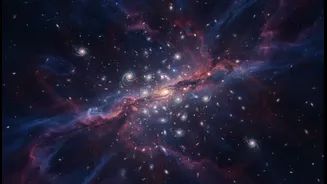
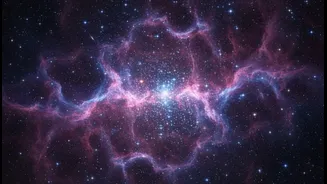
Imagine a kindergarten class where all the children are born on the same day, from the same family, but all weigh different amounts. This is the essence of a young star cluster. These groups, known as open clusters, consist of tens to thousands of stars
formed from the same giant cloud of gas and dust. Because they share the same age and origin, they provide a controlled environment for studying how stars live and die. Unlike ancient, tightly packed globular clusters, open clusters are relatively young and loosely bound, often found within the spiral arms of galaxies like our own Milky Way. They are active, dynamic places where the story of stellar evolution begins.
A Perfect Stellar Laboratory
The key to a star cluster's scientific value is its uniform nature. Since all stars within it are at roughly the same distance and have the same chemical makeup, the main difference between them is their mass. This makes clusters an ideal laboratory for testing theories of stellar evolution. Massive stars burn through their fuel rapidly, living short, brilliant lives before exploding as supernovae. Lower-mass stars, by contrast, are slow and steady, shining for billions of years. By observing which stars in a cluster have started to die, astronomers can accurately determine the cluster's age. This is like looking at a group photo and guessing its age based on how old the biggest and most energetic members look.
Reading the Cosmic Clock
The point at which stars in a cluster begin to peel off from their main hydrogen-burning phase is called the 'main-sequence turn-off'. This point acts as a precise cosmic clock. By plotting the brightness and temperature of a cluster's stars on a chart, astronomers can see this turn-off and deduce how long the stars have been shining. This method allows us to build a timeline of star formation across the galaxy. Recent research has taken this a step further, using the integrated light from clusters to estimate not just their own age but also to provide independent limits on the age of the universe itself.
Mapping the Milky Way's Story
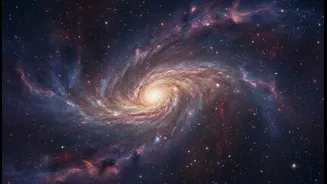
Young star clusters don't just tell us about the lives of stars; they also map the structure of our galaxy. Since these clusters are born in the spiral arms, their distribution helps us trace the shape of the Milky Way, something that's difficult to do from our position inside it. By tracking the movement of these clusters, we can understand the gravitational dynamics of our galaxy. Decades ago, the lopsided distribution of ancient globular clusters was one of the first clues that our solar system is not at the centre of the galaxy, but rather in its suburbs. Young clusters continue this tradition, providing the data points needed to sketch our galactic home.
The Next Chapter with Webb
Our ability to read these stellar stories is getting sharper. Telescopes like the James Webb Space Telescope (JWST) are peering through cosmic dust to see clusters in their earliest, most hidden phases. Recent observations have revealed surprising details, such as how the most massive clusters clear away their birth clouds of gas and dust much faster than smaller ones. This process, known as stellar feedback, has profound implications for how galaxies regulate their own growth and where planets might form. These new insights are refining the narrative, giving us a more detailed and dynamic picture of how galaxies build themselves over cosmic time.