





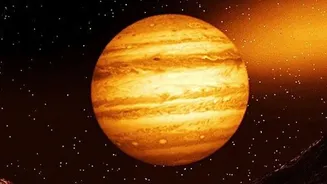
A Steamy Signal from a Distant World
Astronomers have detected signs of water vapour around a rocky exoplanet known as GJ 486 b. This world is classified as a 'super-Earth'—a type of planet more massive than Earth but lighter than ice giants like Neptune. Super-Earths are one of the most
common types of planets found in our galaxy, yet none exist in our own solar system, making them a fascinating subject of study. GJ 486 b is about 30% larger and three times more massive than our planet and orbits a red dwarf star 26 light-years away. However, this is no temperate paradise. The planet is incredibly hot, with a surface temperature estimated at 430 degrees Celsius, making it far too hot to host liquid water or life as we know it.
How the Webb Telescope Peeks at Alien Air
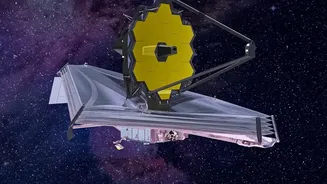
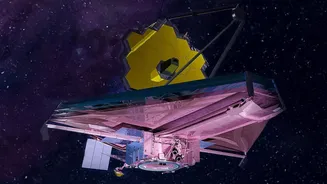
The James Webb Space Telescope doesn't see atmospheres directly. Instead, it uses a clever technique called transit spectroscopy. As an exoplanet passes in front of its host star, a tiny fraction of the starlight filters through the planet's atmosphere, if one exists. The gases in that atmosphere absorb specific frequencies, or colours, of light, leaving a unique chemical fingerprint on the starlight that reaches the telescope. JWST's powerful Near-Infrared Spectrograph (NIRSpec) is exquisitely sensitive to these fingerprints. By analysing the spectrum of light, scientists can identify the molecules present. In the case of GJ 486 b, the data revealed a distinct signature that strongly suggested the presence of water vapour.
A Planet's Atmosphere or a Star's Mirage?
While the detection of water is exciting, scientists are exercising caution. There is a cosmic catch: the water vapour might not belong to the planet at all. The host star is a cool red dwarf, and these types of stars can have cool regions called starspots that are chilly enough for water vapour to form in the star's own outer layers. The signal Webb detected could potentially be from these starspots, creating a kind of cosmic mirage that mimics a planetary atmosphere. “We see a signal, and it's almost certainly due to water,” explained Sarah Moran, lead author of the study from the University of Arizona. “But we can't tell yet if that water is part of the planet's atmosphere… or if we're just seeing a water signature coming from the star.” Further observations with other JWST instruments will be needed to distinguish between the two possibilities.
Why This Still Matters for the Search for Life
Even with the uncertainty, this finding is a landmark achievement. Detecting any potential atmospheric signal around a rocky exoplanet is a huge step forward. For years, astronomers have wondered if rocky planets, especially those orbiting active red dwarf stars, could even hold onto their atmospheres over billions of years. If GJ 486 b does have an atmosphere, it would prove that such worlds can maintain or replenish their gaseous envelopes, even in harsh conditions. This would be a crucial piece of the puzzle. It would suggest that the galaxy might be filled with rocky worlds that have atmospheres, dramatically increasing the number of potential targets in the search for habitable environments.
A New Era of Exploration
This discovery, whether it's ultimately confirmed as a planetary atmosphere or a stellar feature, showcases the revolutionary power of the James Webb Space Telescope. It represents the beginning of a new chapter in exoplanet science: the characterisation of rocky worlds. Before Webb, such detailed observations of small, rocky planets were largely out of reach. Now, we are taking our first tentative steps into studying the air of other Earth-like worlds. Each observation refines our techniques and brings us closer to answering the ultimate question: are we alone? The case of GJ 486 b is not the end of the story, but a thrilling and complex new beginning in our cosmic detective work.