


A Finale's Shocking Revelation
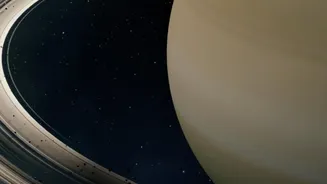
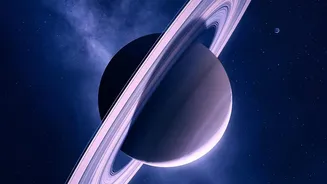
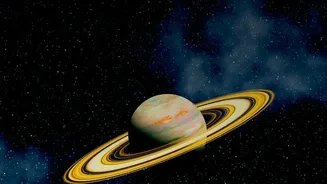
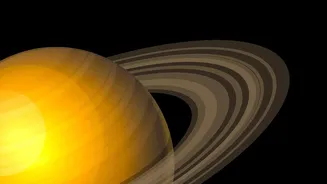
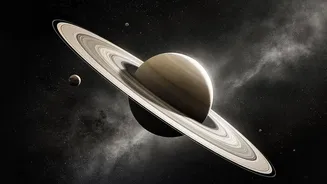
For 13 years, NASA's Cassini spacecraft circled Saturn, revolutionizing our understanding of the gas giant. Before its dramatic final plunge into the planet's atmosphere in 2017, it performed a series of daring dives between the planet and its rings.
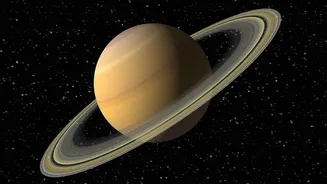
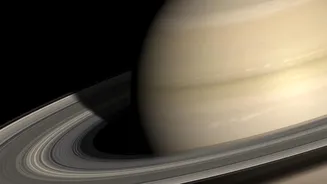
The data it sent back was stunning. By precisely measuring the mass of the rings, scientists made a startling calculation: they were far less massive than expected. This low mass implied the rings couldn't be as old as Saturn itself. If they had been around for 4.5 billion years, they would have been polluted by a constant rain of dark, interplanetary dust, making them appear much dirtier than their bright, icy composition suggests. The conclusion was almost heresy: Saturn's most famous feature might be a relatively new phenomenon, perhaps only 10 million to a few hundred million years old. This means they could have formed after the dinosaurs had already disappeared.
The Cosmic Crime Scene
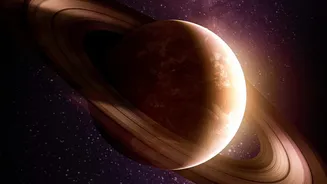
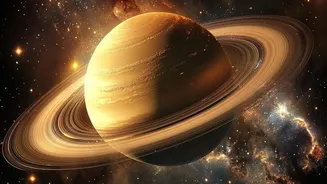
This discovery turned the question of the rings' origin into a cosmic crime scene. Two main camps of thought have emerged. The 'young ring' theorists propose a cataclysmic event in the relatively recent past. One leading theory suggests a large, icy moon—hypothetically named 'Chrysalis'—strayed too close to Saturn. Caught in the planet's immense gravitational pull, it was ripped apart in a process defined by the Roche limit, with its icy debris spreading out to form the spectacular rings we see today. Another scenario involves the collision of two icy moons that shattered, scattering ice into orbit. New computer simulations show this could explain why the rings are almost entirely made of pure water ice, with very little rocky material. These theories suggest we are living in a special time, witnessing a fleeting spectacle.
A Case for Ancient Rings
However, not everyone is convinced. Some researchers argue that the rings could indeed be ancient, forming at the same time as Saturn 4.5 billion years ago. They contend that the rings' pristine appearance isn't proof of youth but of an efficient cleaning mechanism. A 2026 study reported in Nature Geoscience, for example, proposed that incoming micrometeoroids might not just pollute the rings but could vaporize upon impact, with the resulting particles being either pulled into Saturn or ejected from the system, thus keeping the rings looking fresh. Another study suggests that the rings have a natural 'conveyor belt' system, where material is lost at the inner and outer edges, which could cause them to converge on the lower mass Cassini observed, regardless of their initial size. This enduring debate highlights how the same data can be interpreted in different ways, keeping the mystery alive.
Racing a Clock and Inspiring the Future
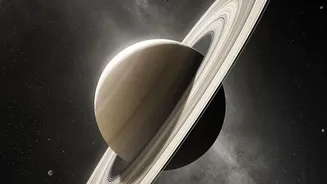
Adding to the urgency is another of Cassini’s discoveries: the rings are disappearing. The spacecraft observed what is known as 'ring rain,' where ring particles are pulled along magnetic field lines into Saturn’s upper atmosphere. The rate of loss is staggering, with enough water to fill an Olympic-sized swimming pool draining every half hour. At this rate, the rings could be gone in as little as 100 million years—a cosmic blink of an eye. This finite lifespan makes solving the puzzle of their origin even more compelling. The mystery is directly fuelling the next generation of space exploration. Scientists are developing proposals for new missions that would follow in Cassini's footsteps. One such concept, NASA's PRAXIS (Planetary Rings Autonomous Exploration with In-situ Sampling), aims to use an AI-guided robotic arm to physically touch and sample ring particles for the first time ever. Such a mission could definitively answer questions about the rings' composition and age, not just for Saturn, but for other ringed bodies in our solar system and beyond.