




What Exactly Was Discovered?
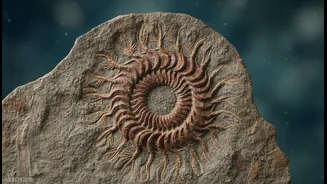
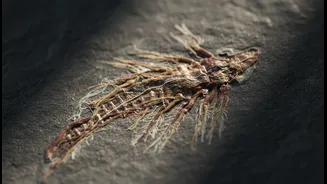
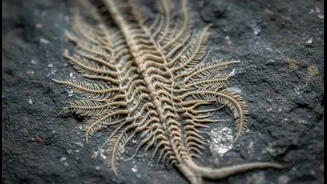
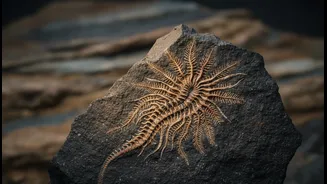
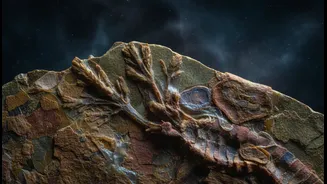
Paleontologists from the University of Oklahoma identified the fossilized remains of an ancient sea creature called a crinoid, an early relative of modern starfish and sea urchins. The specific species is Dendrocrinus simcoensis. These animals, which
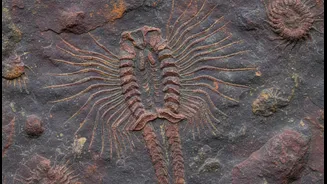
resembled stalked sea flowers, populated Earth's shallow oceans long before the first dinosaurs. While crinoid fossils are quite common, they almost always consist of the hard, skeletal plates of the animal. This discovery was astonishing because it included preserved soft tissues—specifically, the delicate tube feet the animal used for feeding and movement. The find represents only the second time in history that soft tissues have been documented in a crinoid fossil, and it is by far the oldest example ever found.
Why Is Soft Tissue Preservation So Rare?
When an animal dies, its soft parts like skin, organs, and muscles are the first things to decompose. This process happens quickly, usually leaving only hard materials like bones, teeth, or shells to be fossilized over millions of years. For soft tissue to be preserved, a sequence of truly extraordinary environmental conditions must occur almost immediately after death. The environment essentially has to act like a natural 'vacuum-sealer,' cutting off the decaying effects of oxygen and bacteria. This typically requires the animal to be buried rapidly in fine-grained sediment in an oxygen-poor setting, allowing minerals to replace the organic matter before it vanishes completely.
The 'Fool's Gold' Secret
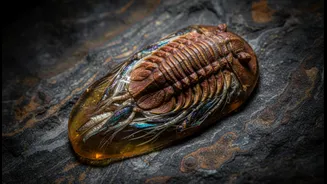
In the case of this ancient crinoid, the soft tissues were preserved through a process called pyritization. Pyrite, a mineral also known as 'fool's gold,' is an iron sulfide. Under specific anaerobic (oxygen-deficient) conditions in marine sediments, bacteria that convert sulfates into sulfides can thrive. If there is dissolved iron in the water, it reacts with these sulfides to form pyrite. This mineral then replaces or coats the decaying organic structures, creating a stunningly detailed metallic cast of the original tissue. The crinoid's tube feet were preserved as slightly raised, pyritized structures, a golden ghost of their living form from 450 million years ago.
What This Tells Scientists
Finding these tube feet provides invaluable information that skeletons alone cannot. It offers direct evidence of how these ancient creatures lived and fed. By studying the anatomy of these soft parts, scientists can better understand the ecology of Earth’s earliest complex reef ecosystems. This fossil helps researchers reconstruct the evolutionary pathways of crinoids and their relatives, revealing how their feeding strategies and behaviors may have changed over hundreds of millions of years. Such finds allow for more accurate comparisons between extinct species and their modern relatives, like today's feather stars, helping to piece together the vast and complex history of life in our oceans.
A Museum's Hidden Gem
This remarkable fossil wasn't unearthed in a new dig. It was discovered sitting in the collection of a small, community-supported museum in Montréal, the Musée de paléontologie et de l'évolution. The specimen’s true significance was overlooked until researchers from the University of Oklahoma visited and studied it. This highlights the critical role that museum collections, both large and small, play in scientific discovery. As new technologies and new expertise emerge, specimens collected years ago can yield groundbreaking insights, proving that sometimes the next great discovery is already waiting on a shelf.