


The Illusion We All Experience
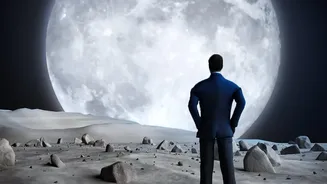
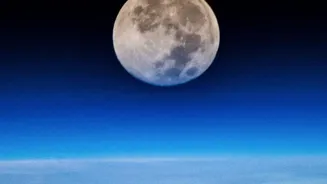
It’s one of the most reliable and awe-inspiring sights in nature. A full moon rising over a city skyline or a line of distant trees appears colossal, dwarfing its apparent size when it's high overhead later that night. This phenomenon, known as the Moon
illusion, has been documented for thousands of years, puzzling everyone from ancient Greek philosophers to modern-day scientists. You can even prove it's an illusion yourself. Hold a small coin at arm's length to cover the horizon moon, then try again when it's at its zenith. You'll find the moon is the same size in both instances. Photographs also confirm that the moon's angular size doesn't change, proving the effect is not physical but perceptual.
It’s Not the Atmosphere
A common myth is that the Earth's atmosphere acts like a magnifying glass for the low-hanging moon. While the atmosphere does affect the moon's appearance, it doesn't make it look bigger. In fact, atmospheric refraction slightly squashes the moon's image vertically, making it appear a tiny bit smaller, not larger. The atmosphere is responsible for the moon's colour change, however. When the moon is near the horizon, its light travels through more of the atmosphere to reach our eyes. This scatters more of the shorter, blue wavelengths of light, allowing the longer, redder wavelengths to pass through, which is why a rising moon often has a yellow, orange, or reddish hue.
Your Brain Is the Culprit
The secret behind the Moon illusion lies not in the sky, but between your ears. It’s a cognitive trick, an error in how your brain processes visual information. Our brains have evolved to make sense of a three-dimensional world, and they use various cues to judge the size and distance of objects. This system works remarkably well for terrestrial objects, but it gets confused when looking at something as far away as the moon. The leading explanation for this mental mix-up is known as the 'apparent distance hypothesis'.
The Ponzo Illusion at a Cosmic Scale
The apparent distance hypothesis is best understood through a classic optical illusion called the Ponzo illusion. Imagine two identical lines drawn between a pair of converging lines, like railway tracks stretching into the distance. The line that's 'farther away' (closer to where the tracks converge) appears larger than the one that's 'closer'. Your brain, interpreting the converging lines as a sign of distance, automatically scales up the top line, assuming it must be bigger to project the same size image from farther away. The Moon illusion works on a similar principle.
The Role of Trees and Buildings
This is where the landscape comes in. When the moon is on the horizon, it is seen alongside trees, buildings, and mountains. These are objects whose distance and size we are familiar with. This rich tapestry of terrestrial cues provides your brain with a sense of immense depth, suggesting the moon is very far away, at the end of all that scenery. Because the moon on the horizon is perceived as being farther away than the moon in the empty expanse of the zenith sky, your brain applies the same logic as the Ponzo illusion. It concludes that for an object that appears so far away to have that angular size, it must be physically enormous. In the empty sky overhead, with no objects for comparison, your brain perceives the moon as being closer and therefore smaller.
A Puzzle Not Quite Solved
While the apparent distance hypothesis is the most widely accepted explanation, the Moon illusion is a complex topic with no single, universally agreed-upon cause. Scientists point to a 'size-distance paradox': most people say the horizon moon looks both larger and closer, which contradicts the idea that it's perceived as farther away. Other theories, such as the 'relative size hypothesis' and the 'angle of regard hypothesis', suggest different brain mechanisms might be at play. Even astronauts in orbit, with no terrestrial cues at all, have reported experiencing the illusion, suggesting there's still more to learn about this fascinating trick of the mind.