

The Sun’s Restless Nature
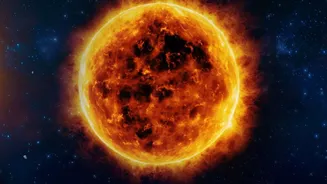
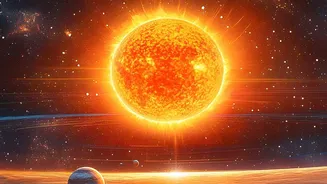
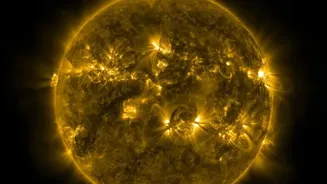
The sun isn't a static ball of fire; it's a dynamic, churning star with powerful magnetic fields. These fields twist, stretch, and reorganise in a process that follows a roughly 11-year cycle, moving from a quiet 'solar minimum' to a chaotic 'solar maximum'.
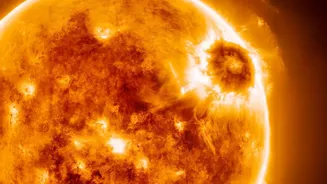
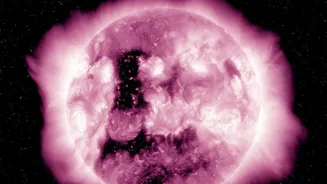
During the peak of this cycle, the sun's surface is often dotted with sunspots—cooler, darker areas that are hubs of intense magnetic activity. It is from these active regions that two major types of solar eruptions can occur: solar flares and coronal mass ejections (CMEs). Think of a solar flare as a gigantic flash—a sudden, intense burst of radiation. A CME, on the other hand, is a physical eruption, flinging billions of tonnes of plasma and magnetic fields from the sun's outer atmosphere (the corona) into space at incredible speeds. While they often happen together, they are distinct events with different effects.
When a Solar Storm Reaches Earth
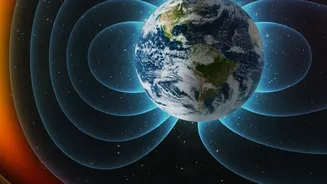
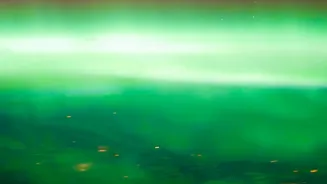
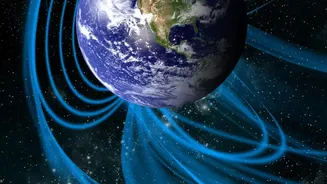
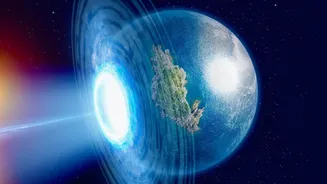
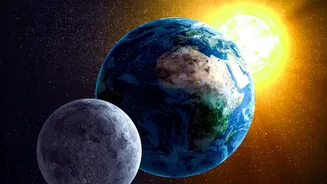
A solar flare's radiation travels at the speed of light, reaching Earth in about eight minutes. While our planet's atmosphere and magnetic field protect life on the ground from this radiation, it can interfere with high-frequency radio communications, especially on the sunlit side of the Earth. A CME is a different beast. This massive cloud of magnetised particles travels much slower, taking anywhere from 15 hours to several days to cross the 150-million-kilometre journey to Earth. When this cloud slams into Earth's protective magnetic field (the magnetosphere), it causes a major disturbance known as a geomagnetic storm. The most famous and beautiful consequence of this interaction is the aurora—the Northern and Southern Lights. During strong storms, these stunning light displays can be seen far from the polar regions.
Risks to Our Digital Infrastructure
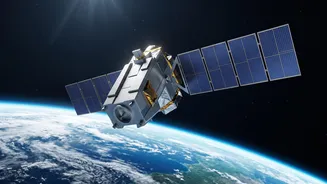
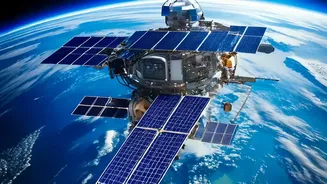
While auroras are beautiful, geomagnetic storms pose a significant risk to our modern, technology-dependent society. Satellites orbiting outside the protection of most of the atmosphere are particularly vulnerable. The charged particles can damage electronics, degrade solar panels, and cause 'phantom commands'. Intense storms also heat and expand the upper atmosphere, increasing drag on low-orbiting satellites and causing them to lose altitude. Down on Earth, the biggest concern is the electrical grid. Geomagnetic storms can induce powerful currents in long transmission lines, potentially overloading transformers and causing widespread blackouts. Furthermore, GPS navigation systems can lose accuracy, radio communications can be disrupted, and even pipelines can be affected.
Measuring the Storm’s Fury
Not all solar storms are created equal. Scientists use scales to classify their intensity. Solar flares are ranked by their X-ray brightness in classes A, B, C, M, and X, where each class is ten times more powerful than the last. C-class flares are generally minor, while X-class flares are the most powerful and can trigger worldwide radio blackouts. Geomagnetic storms are measured on a G-scale from G1 (minor) to G5 (extreme). A G1 storm might cause brief satellite glitches and bright auroras, while a G5 event, like the historic Carrington Event of 1859, could have catastrophic consequences for our modern power and communication networks.
India’s Eye on the Sun
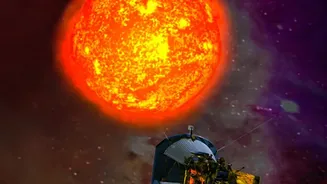
Predicting space weather is key to protecting our infrastructure. The time it takes a CME to travel to Earth provides a crucial warning window, allowing satellite operators and grid managers to take protective measures. India has taken a significant step in this direction with its Aditya-L1 mission. Positioned 1.5 million kilometres from Earth, it has an uninterrupted view of the sun. Its instruments can detect CMEs and solar flares, providing early warnings and crucial data for scientists. This allows India to not only contribute to the global understanding of space weather but also to build a shield for its own critical infrastructure, from communication networks to the power grid, as the sun moves through its active cycles.