



The Sun’s Powerful Outbursts
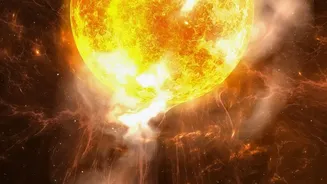
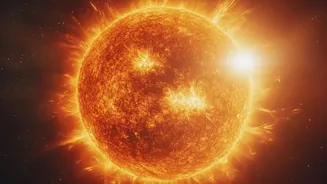
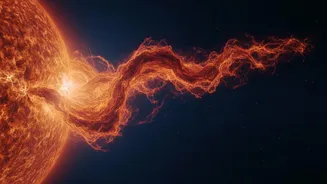
The primary cause of this 'space weather' is a phenomenon known as a Coronal Mass Ejection, or CME. A CME is a massive eruption of plasma and magnetic fields from the Sun's outer atmosphere, the corona. These are not small events; a single CME can release
billions of tonnes of material into space, travelling at speeds of hundreds or even thousands of kilometres per second. While the Sun produces CMEs regularly, with several per day during its active periods, only a fraction are directed towards Earth. However, when one is aimed our way, it can have significant consequences.
When Space Weather Turns Stormy
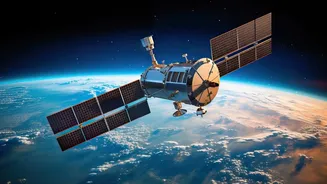
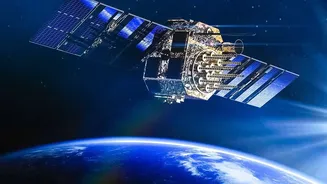
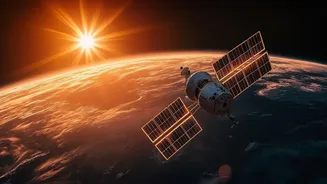
When a CME collides with Earth's magnetic field, it triggers a geomagnetic storm. While these storms can produce beautiful auroras, they also pose a serious risk to our modern way of life. The intense influx of energy and particles can damage satellites, disrupting communications and GPS navigation. They can induce powerful electrical currents in power grids, potentially causing widespread blackouts. The historical Carrington Event of 1859, the largest recorded geomagnetic storm, set telegraph systems on fire. In today's world, a storm of that magnitude could be catastrophic, highlighting the urgent need for accurate warnings.
A New Era of Predictive Modeling
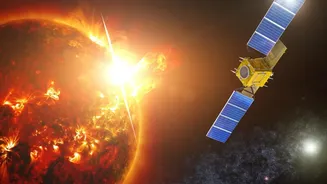
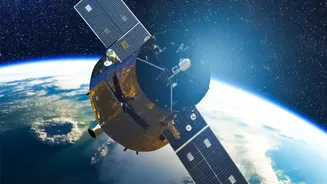
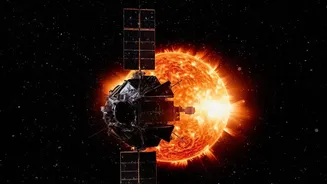
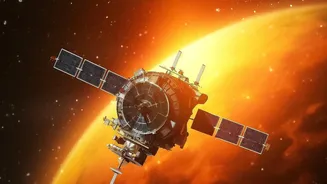
For years, predicting the impact of a CME was fraught with uncertainty. Scientists could see an eruption leave the Sun, but had to guess its path and intensity. Today, that is changing thanks to a revolution in impact modeling, powered by a combination of new spacecraft and artificial intelligence. Missions like ISRO's Aditya-L1, NASA's PUNCH, and ESA's Solar Orbiter provide a constant stream of high-resolution data, observing CMEs from multiple vantage points. This wealth of information is fed into sophisticated computer models. AI and machine learning algorithms can now rapidly analyze images and data to determine a CME's speed, trajectory, and magnetic orientation — key factors that determine its potential impact.
From Hours of Uncertainty to Minutes of Precision
These enhancements are making space weather forecasts more accurate than ever. In a recent test using data from NASA's PUNCH mission, scientists were able to predict a CME's arrival at Earth with an accuracy of within 30 minutes. This is a monumental leap forward from older methods, which had an error window of around five hours. This level of precision is crucial. It gives power grid operators, airlines, and satellite companies the critical lead time needed to take protective measures, such as temporarily powering down sensitive systems or rerouting flights. India's Aditya-L1 plays a key role, providing early warnings from its strategic position 1.5 million kilometres from Earth.
A Global Shield for a Connected Planet
This improved monitoring isn't just about protecting assets on Earth. As humanity expands its presence in space with missions to the Moon and Mars, protecting astronauts and robotic explorers from hazardous solar radiation becomes paramount. Better forecasting helps safeguard these interplanetary missions. The effort is a worldwide collaboration, with agencies like ISRO, NASA, and ESA sharing data and expertise. This global network of observatories, both on the ground and in space, functions as a planetary-scale early warning system. By understanding the Sun's behaviour in greater detail, we are building a more resilient future for our increasingly connected and space-faring civilization.